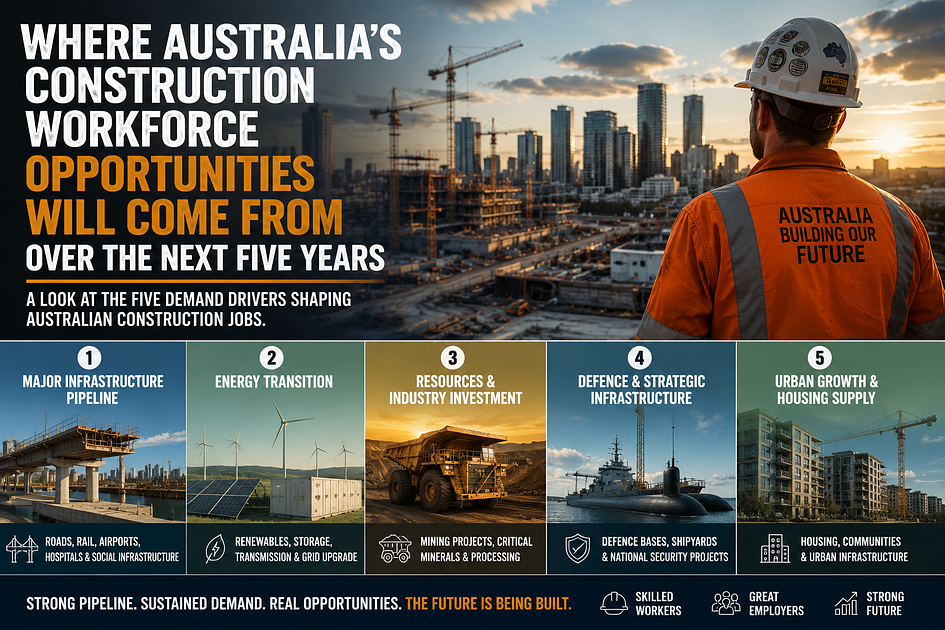
Where Australia's Construction Workforce Opportunities Will Come From Over the Next Five Years
Australia is building more infrastructure, more housing, more energy generation, and more industrial capacity than at almost any point in the country's history. The project pipeline $242 billion of funded major projects across transport, energy, defence and social infrastructure represents years of forward work across every state and most regions.
For workers, employers, recruiters and industry followers trying to read the forward picture, the question isn't whether there's work coming. It's where it's concentrated, which disciplines it favours, how long it runs, and what skills it needs. This article pulls together the clearest threads of Australia's five-year construction employment outlook a practical synthesis of what the pipeline means for the people who actually build it.
The Five Demand Drivers That Shape the Next Five Years
Australia's forward construction employment picture is shaped by five simultaneous demand drivers, each of which has a distinct timeline, geography and workforce profile.
1. Transport infrastructure - the foundation layer
Roads, rail, tunnels and bridges remain the largest single component of Australia's infrastructure investment. The programs underway in Victoria, NSW and QLD alone represent multi-year civil construction employment for tens of thousands of workers. Inland Rail's regional corridor, Sydney Metro West, and South-East Queensland transport investment are all active or approaching peak construction delivery. Transport infrastructure employs the broadest range of construction workers from civil labourers through to specialist tunnelling crews and project engineers and its scale means it will anchor the construction labour market throughout the forecast period.
2. Energy transition - the fastest-growing segment
Renewable energy construction: solar, wind, batteries, pumped hydro, and transmission is the fastest-growing construction sector in the country and will reach its investment peak around 2027/28. As detailed in the renewable energy construction boom, this sector is concentrated in regional and rural areas and creates specific civil, electrical and structural demand that is distinct from most building and transport construction. After the peak, the operational maintenance and upgrade cycle begins meaning the sector generates employment in a different form rather than simply stopping.
3. Defence and national security - the long-duration program
AUKUS and the broader Australian defence estate construction program are the longest-duration investment in the current pipeline running over decades rather than years. WA and SA are the primary geographies for the submarine-related construction, but defence facility upgrades are active nationally. As covered in the AUKUS workforce article, this sector offers something unusual in construction program stability measured in decades rather than months.
4. Resources and critical minerals - the export engine
Mining construction and operational workforce demand continues across WA's Pilbara and Goldfields, Queensland's resources regions, and the emerging critical minerals sector nationally. The transition from conventional resources to critical minerals: lithium, copper, cobalt, nickel is generating new project construction activity in locations that previously had limited resources investment. The combined effect is that Australia's resources-related construction and FIFO employment market remains one of the most active in the world.
5. Social infrastructure - housing, health and education
The social infrastructure investment wave driven by housing affordability policy, aged care reform, health system investment, and school building programs generates demand primarily for building construction trades rather than civil. Carpenters, concreters, plumbers, electricians, plasterers and other building trades are all active beneficiaries of this pipeline, which is distributed across all states and concentrated in capital cities and major regional centres.
Where the Regional Workforce Pressure Is Most Intense
Infrastructure Australia's 2025 assessment identified a striking forecast: while the urban construction workforce shortage is projected to ease significantly by 2029, the regional shortfall is projected to quadruple within a single year at its peak.
This regional intensification reflects the geography of the energy and resources pipeline. Solar farms, wind projects, battery storage, mining construction, pipeline and water infrastructure the dominant growth areas in the current pipeline are almost exclusively regional. The workers needed to build them are competing for accommodation, flights and basic services in communities that were never designed to support major project construction at this scale.
For workers prepared to engage with regional construction work, this regional intensification represents the clearest employment opportunity in the market. The combination of project availability, rate premiums for remote work, and relatively limited competition from metropolitan-focused workers creates favourable conditions for workers who make the geographic commitment.
The Skills That Will Be Most in Demand
Across all five demand drivers, certain skills and disciplines appear consistently:
High-demand throughout the period:
- Civil labourers and earthworks operators - the baseline of any civil and resources project
- Formwork carpenters and concreters - required across transport, building and energy projects
- Electricians - the energy transition layer alone creates extraordinary ongoing electrical demand
- Experienced site supervisors and leading hands consistently the hardest-to-fill roles across every sector
Specialist skills commanding premium rates:
- Tunnelling crews - urban rail programmes in Melbourne and Sydney
- Marine civil workers - AUKUS Henderson precinct and port infrastructure
- High-voltage electrical - transmission lines and grid connection infrastructure
- Structural steel - defence facilities, energy structures, and transport infrastructure
Growing demand over the period:
- Hydrogen infrastructure construction - behind the current renewables wave
- Critical minerals processing facility construction - lithium refineries, battery material processing
- Advanced manufacturing facility construction - industrial precincts, particularly in regional areas
What This Means for Workers Planning Their Next Move
For workers trying to navigate this environment, the forward picture is genuinely favourable but navigating it well requires some planning. The most useful framing:
- Where is your current experience most applicable? Match your trade and project history to the sectors where demand is strongest
- Are your tickets current and complete? The employers with the most attractive roles have the most options. Workers who arrive with every relevant ticket in order get first consideration
- Are you flexible on geography? Regional flexibility is the single most effective way to expand your access to the current pipeline
- Are you thinking about career progression? The sustained demand for supervisors, leading hands and project managers means this is one of the best environments in a generation to step up, if you're ready
For employers, the five-year picture reinforces the case for early workforce planning, investment in retention, and proactive sourcing well ahead of project mobilisation. The employers who will deliver Australia's construction pipeline successfully are the ones treating workforce as a strategic asset rather than a procurement line item.
The Work Is There The Question Is Whether the Industry Is Ready
Australia's construction pipeline is as large and as well-funded as it has ever been. The workforce gap is real, but it's not insurmountable it requires coordinated action across training, migration, diversity and retention, sustained over the next several years. For workers who are skilled, flexible and engaged with the industry's forward direction, the next five years represent a genuinely significant opportunity.
Browse current roles across construction, civil, mining, energy and infrastructure at Construction Jobs Australia and explore how CJ Recruitment Global supports employers and candidates across Australia's construction and resources pipeline.