AUKUS and Australia's Defence Construction Program: What It Means for the Workforce
Australia's defence infrastructure commitment under the AUKUS agreement is generating a construction and industrial program that, in scale and duration, is unlike almost anything the country has undertaken before. The numbers are significant $12 billion in committed infrastructure investment at Henderson in WA, a submarine construction yard in SA, and a broader defence facilities programme that will run across the country for decades.
For construction workers, civil contractors and employers trying to understand the forward employment picture, defence infrastructure deserves serious attention. It's not as widely discussed in construction industry circles as renewable energy or Olympic infrastructure but the scale, the duration, and the specialised workforce demand it creates make it one of the most consequential construction programmes in the current pipeline.
What the AUKUS Construction Program Involves
The AUKUS partnership between Australia, the United States and the United Kingdom has at its centre the acquisition of nuclear-powered submarines for the Royal Australian Navy. The construction and industrial implications of this commitment extend far beyond the submarines themselves.
Henderson, Western Australia - $12 billion defence precinct
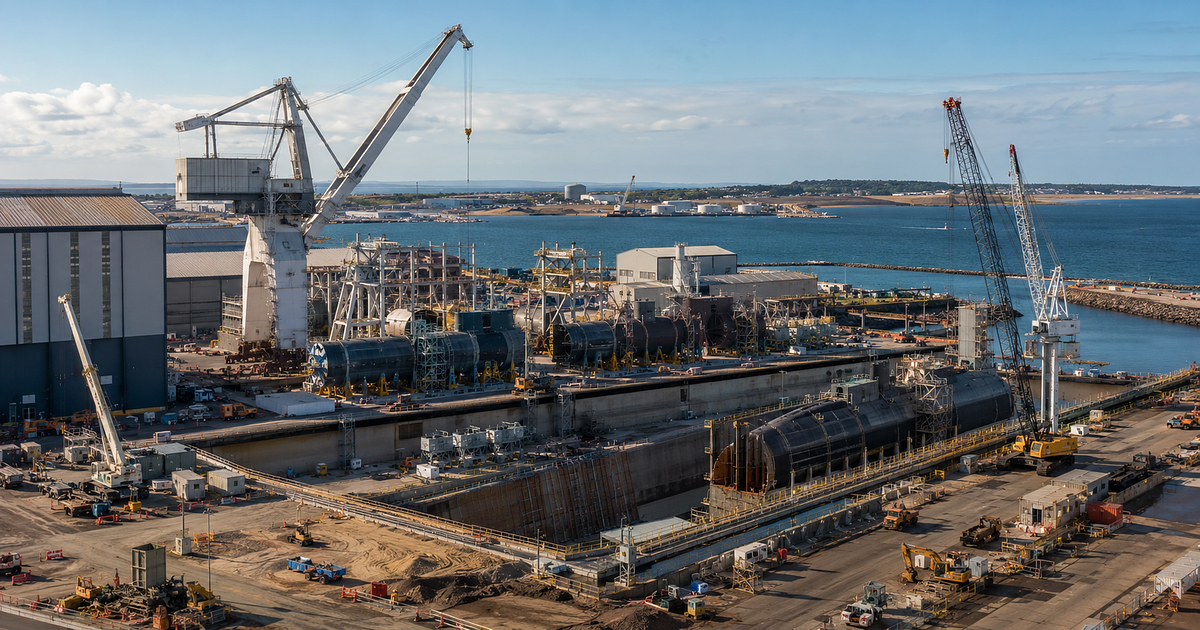
The Henderson shipyard south of Perth has been designated as the primary maintenance and sustainment hub for AUKUS submarines in the Indo-Pacific. The infrastructure investment required to make Henderson capable of this role is estimated at between $12 billion and $20 billion covering submarine berths and dry docks, maintenance facilities, support buildings, utilities and services infrastructure, security and access systems, and the marine civil works that underpin all of it.
Approximately 1,000 construction jobs are expected at Henderson during the infrastructure build phase, with a further 300 submarine maintenance roles, 1,200 surface vessel construction jobs, and around 1,100 landing craft positions flowing from the broader program. Combined, the Henderson precinct is expected to rival WA's resources sector as an employer a statement that puts the scale in perspective for anyone familiar with how large that sector is.
Osborne, South Australia - submarine construction yard
At its peak, up to 4,000 workers will be employed to design and build the submarine construction infrastructure at Osborne in SA. The construction yard itself the physical facility for assembling nuclear-powered submarines is a major industrial construction project in its own right, requiring specialist civil, structural, mechanical and services construction expertise. The overall AUKUS program is projected to create around 20,000 direct jobs over 30 years, with the construction workforce peaking in the 2030s as the submarine building programme reaches full capacity.
Broader defence facilities
Beyond the submarine program, Australia's defence estate more broadly is undergoing significant investment. HMAS Stirling in WA, Larrakeyah in the NT, and various air force and army facilities nationally are subject to capital investment programmes that generate civil and building construction demand on a rolling basis.
Why This Matters for the WA Construction Market
For WA specifically, the AUKUS construction programme lands on top of an already heavily loaded construction market. The Pilbara resources sector, critical minerals construction in the Goldfields and mid-west, Perth metropolitan housing and infrastructure, and now Henderson defence infrastructure are all competing for the same civil, structural and mechanical workforce.
WA's civil construction industry has publicly stated its confidence in meeting the Henderson demand but that confidence comes with caveats. Accommodation in Perth's southern suburbs near Henderson is constrained. The trades most needed for marine civil and structural work concreters, structural steel workers, marine civil specialists and mechanical fitters are already in demand from the resources sector. The competition for experienced workers will be intense.
For workers in structural, civil and mechanical trades who are willing to work in the Perth metropolitan area or relocate to WA, the Henderson programme represents a decade-plus of well-funded project work in a sector that tends to deliver consistent project management quality and timely payment. Defence infrastructure projects have a different risk profile from some private-sector construction the sovereign funder and the long-term nature of the programme reduce many of the delivery uncertainties common in resource-sector construction.
The Skill Sets in Demand
Defence construction particularly for the submarine and naval precinct work requires some skill sets that are in limited domestic supply. The program has recognised this and is actively working with training institutions to build capacity but the lead times on specialist training mean that experienced workers in relevant trades have a significant advantage.
Skill sets with particular relevance to the AUKUS construction program:
- Marine civil and coastal engineering construction wharf construction, drydock civil works, marine piling and structures
- Structural steel and heavy fabrication the construction of submarine maintenance halls and vessel construction facilities involves significant structural steel scope
- Mechanical and hydraulic fitting marine-grade mechanical systems, hydraulic test equipment, and specialist tooling installations
- Electrical and instrumentation defence-grade electrical installations, security systems, and highly controlled building management systems
- Civil and earthworks site preparation and civil infrastructure for the precinct development is conventional civil work at large scale
For workers in civil, structural and mechanical trades who want to understand how to position for opportunities in this sector, maintaining current tickets and building relevant project experience is the foundation as outlined in the construction tickets and certifications most worth having in the Australian market.
A Long-Term Programme, Not a Single Project
One of the most important things to understand about AUKUS construction is its duration. This isn't a three-year project. The submarine programme runs for thirty years. The infrastructure that supports it maintenance facilities, accommodation, utilities, security will be built, upgraded, and periodically replaced across that entire period.
This creates a fundamentally different employment dynamic from a typical construction project. Workers who enter the defence construction sector and develop relevant skills and clearances can build careers within it not just complete a single project and move on. The security clearance requirements involved also create a barrier to entry that, once cleared, represents genuine competitive advantage for the workers who hold it.
What Employers and Workers Should Know
For employers:
- Security clearance requirements add lead time to the hiring process that doesn't exist on most civil or building projects plan for this early
- The program's long duration and sovereign funding make it an attractive basis for direct employment rather than pure labour hire
- WA's labour market tightness means workforce sourcing for Henderson construction needs to begin well ahead of project mobilisation dates
For workers:
- WA residency or willingness to relocate is a practical prerequisite for most Henderson roles
- Defence sector work typically requires National Police Clearance as a minimum; some roles will require higher clearance levels
- The long programme duration makes this a genuine career pathway rather than a single contract opportunity
Browse current civil and construction roles across WA and nationally at Construction Jobs Australia, and for employers building workforce strategies for major defence or civil programs, CJ Recruitment Global provides targeted candidate sourcing support and has access to a global network of experienced construction professionals .