The Renewable Energy Construction Boom: Where the Jobs Are and How Long They'll Last
Australia's renewable energy construction sector has become one of the most significant drivers of workforce demand in the country. Solar farms, wind projects, battery storage, pumped hydro, and transmission infrastructure are generating construction activity at a scale that's reshaping regional economies and creating sustained demand for civil, electrical, structural and plant operation workers across the country.
This isn't a short-term stimulus programme. The transition from coal-fired power to renewable generation is a structural, decade-long build and most of the physical construction hasn't happened yet. For workers and employers trying to understand where consistent project work sits over the next several years, renewable energy construction is one of the clearest answers available.
The Scale of What's Being Built
The numbers involved in Australia's renewable energy buildout are substantial. Industry research from Macromonitor forecasts spending on renewable energy infrastructure to peak at more than $36 billion in 2027/28 having already surged 74% in the four years to 2024. A record 3.3 gigawatts of generation capacity came online in 2025 alone.
The Australian Energy Market Operator (AEMO) forecasts between 5.2 and 10.1 gigawatts of new renewable generation and storage capacity coming online annually through the end of the decade. Alongside this, battery storage projects both utility-scale and grid-connected are being built at an accelerating pace across multiple states.
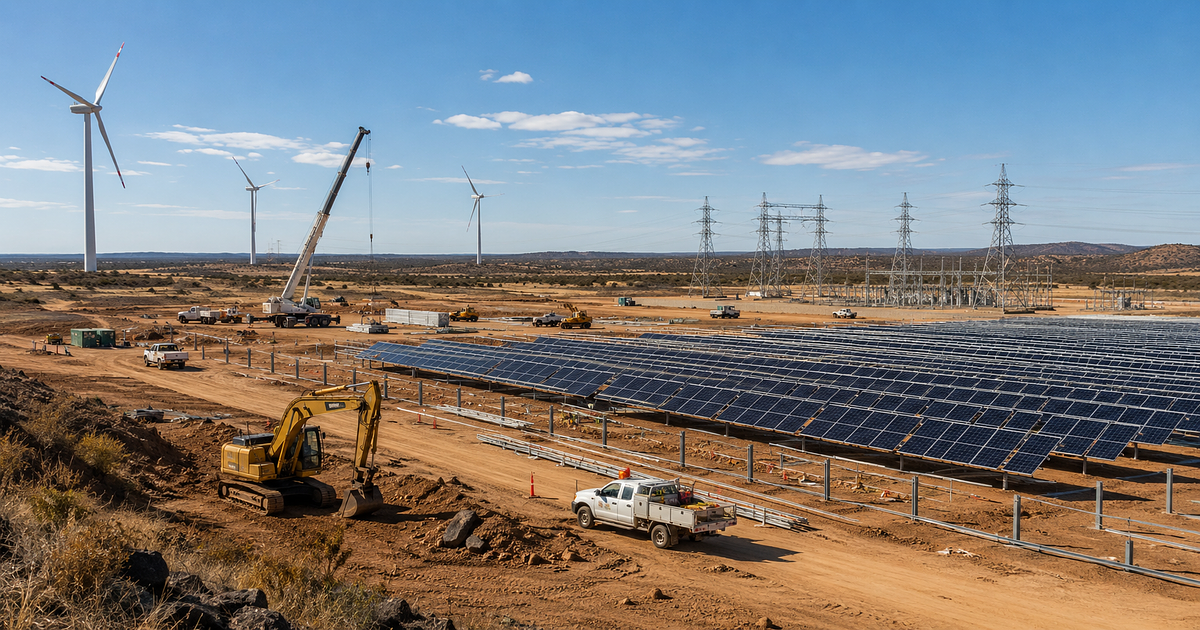
What this translates to on the ground is a sustained pipeline of solar farm construction, wind farm installation, battery and storage facility construction, and the civil and electrical work that connects all of it to the grid. Each of those project types creates its own demand profile for construction and civil workers.
As explored in how the renewable energy buildout is creating a new wave of construction jobs, this wave of activity is already active and intensifying not a future projection.
Where the Projects Are Located
Unlike most forms of infrastructure construction, renewable energy projects are rarely located near major population centres. Solar and wind resources are predominantly in regional and rural areas and that's where the construction workforce needs to be.
Key growth regions for renewable energy construction include:
Central and south-east Queensland major solar and battery storage projects, wind development in the Darling Downs and central highlands. QLD's broader construction pipeline already under significant pressure ahead of 2032 infrastructure demands makes this region one of the most active in the country.
New England and north-west NSW one of Australia's strongest renewable energy zones, with multiple large-scale wind and solar projects across the Tamworth, Armidale and Narrabri regions. Transmission projects connecting this zone to the grid are substantial civil works in their own right.
South Australia the national leader in renewable energy penetration, with continued solar, wind and battery investment. South Australia consistently has the fastest commissioning timelines for new generation projects in the country.
Victoria offshore wind development in Gippsland, onshore wind across the west of the state, and solar across central Victoria are all active or in development.
Western Australia the South-West Interconnected System is undergoing major upgrades, with solar and battery projects adding to a construction market already running hot from resources activity.
For workers prepared to travel or relocate temporarily, this regional concentration is exactly where FIFO and drive-in drive-out construction work is most consistently available.
What Roles Are in Demand
Renewable energy construction creates demand across a wide range of construction and civil disciplines. The specific roles depend on the project type, but the most consistently in-demand across the sector include:
Civil and earthworks
Large solar and wind projects require substantial civil preparation access roads, cable trenching, foundation excavation, drainage works, and site establishment. Civil labourers, excavator operators, grader operators and civil supervisors are all needed at the early phases of these projects.
Electrical and communications
The connection between generation assets and the grid requires significant electrical installation and cable laying work. Licensed electricians with high-voltage experience and communication technicians are in strong demand, particularly on larger solar and transmission projects.
Structural steel and concrete
Wind turbine foundations, substation structures, and battery facility buildings all require structural concrete and steel work trade carpenters, concreters, formwork workers and steel fixers are all active contributors.
Project supervision and management
Project managers, site supervisors, and HSE advisors are consistently needed across renewable energy project portfolios. The compressed delivery timelines on many energy projects create significant demand for experienced supervisors who can manage complex civil and electrical programmes simultaneously.
How Long the Work Will Last
The renewable energy build is a long-cycle programme, not a single project event. The transition away from coal-fired generation creates a sustained replacement demand for new capacity. Each coal plant retirement triggers additional renewable and storage development. Each new industrial precinct or housing development adds load that needs to be served by new generation.
Peak construction activity across the sector is forecast around 2027/28 but activity doesn't drop off a cliff after that. Ongoing maintenance, facility upgrades, and new project development will sustain construction demand well into the 2030s. Add the hydrogen infrastructure pipeline that sits behind the current renewables wave, and the long-term outlook for this sector's construction demand is as strong as any segment of the market.
For workers who develop skills and experience on renewable energy projects now, that background will remain relevant and sought-after for years.
What It Means for Workforce Planning
The renewable energy construction boom creates a specific workforce planning challenge for employers: projects are regional, timelines are compressed, and the trades required span civil, electrical, and structural disciplines simultaneously. This makes workforce sourcing more complex than a standard building or civil project.
Employers building project teams for renewable energy construction benefit from early engagement of labour hire partners, proactive sourcing of regionally available candidates, and investment in direct employment of key trades who can move between projects in a portfolio. The construction workforce shortage is particularly acute in the regions where most renewable energy projects are being built planning around this constraint rather than hoping it resolves is the more reliable approach.
One of the Most Active Sectors in Australian Construction
Renewable energy construction is no longer an emerging sector. It's one of the most active and best-funded areas of Australian construction activity, with a project pipeline that runs through the end of the decade and beyond. For workers looking for sustained, well-paid project work and for employers building workforce capacity for the energy transition, this sector deserves to be at the centre of their planning.
Browse renewable energy construction and civil roles across regional and metro Australia at Construction Jobs Australia.