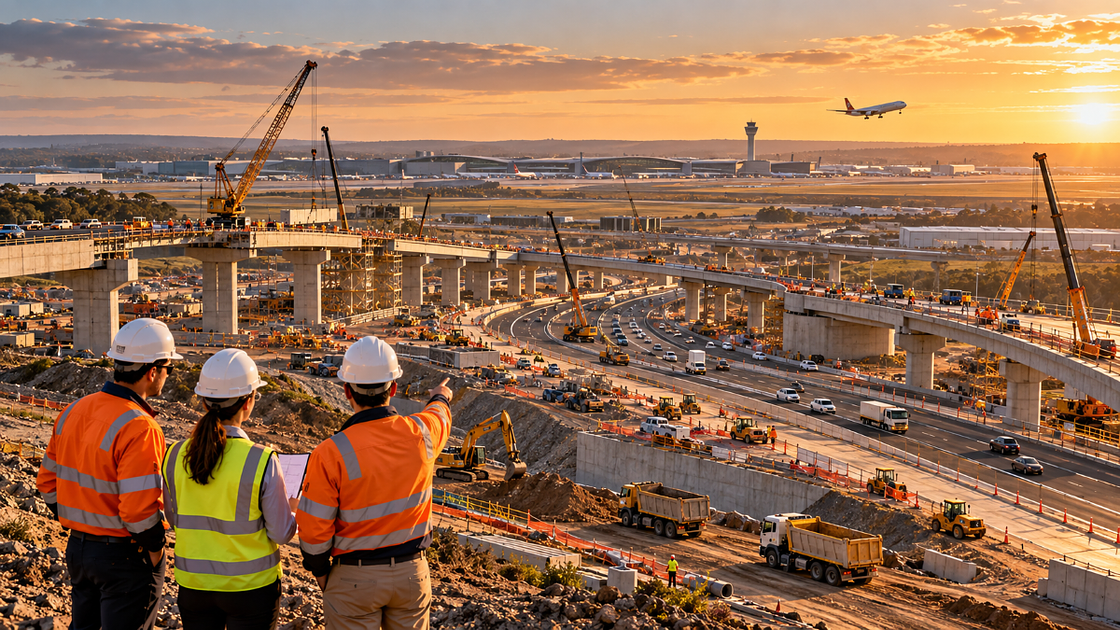
Australian Construction & Infrastructure Update – September 2026
Australia’s major infrastructure pipeline continued to move forward during September 2026, with major road, rail, energy and Olympic-related projects reaching new delivery milestones across several states. At the same time, workforce shortages and changes to migration settings are raising new questions about where the labour required to deliver that pipeline will come from.
September has been a significant month for Australia’s construction and infrastructure pipeline.
Across Western Sydney, Melbourne, Brisbane and regional Queensland, several major programs have moved another step from planning and procurement towards physical delivery. Contracts have been signed, tunnel boring has started, major earthworks are underway and contractors are being brought deeper into the delivery process.
On its own, none of that is unusual for a market the size of Australia. What makes September more interesting is what has been happening alongside it.
Master Builders Australia released new modelling this month estimating the construction industry is currently short around 141,000 skilled workers. The Federal Government announced a new program aimed at converting the experience of up to 6,000 existing construction workers into nationally recognised qualifications.
Then came another change that could have consequences for regional construction employers: second and third-year Working Holiday visas are set to move to a ballot system, placing new caps on the number of people able to remain in Australia for additional years.
Taken together, September has reinforced something the industry has been talking about for a long time.
Australia does not have a shortage of work coming through the pipeline. The bigger question is increasingly where the people required to deliver it are going to come from.
Nearly $3 billion of Western Sydney road contracts locked in
One of the clearest construction announcements of September came from Western Sydney, where contracts have now been signed across five major road projects worth almost $3 billion.
The largest packages are the $1 billion Mamre Road Stage 2 upgrade and the $1 billion Elizabeth Drive upgrade, both awarded to the Gamuda Australia BMD Group joint venture.
Fulton Hogan has been awarded the $440 million Garfield Road East upgrade, BMD Constructions will deliver the $247 million Henry Lawson Drive Stage 1B project, and Ward Civil & Environmental Engineering has been awarded the $190 million Horsley Drive upgrade.
Construction across the five projects is expected to begin later in 2026.
There is a particularly important employment story around this part of Sydney.
Western Sydney International Airport is getting closer to opening, residential development continues to push further west and the industrial precincts surrounding the airport are expanding. The supporting road network now has to catch up.
That means the work is not limited to one major package or one contractor. Over time these projects will pull through demand across civil construction, earthworks, structures, utilities, traffic management, plant, surveying, engineering and project delivery.
For subcontractors and workers across Western Sydney, this is the sort of pipeline that starts to create overlapping demand rather than isolated project recruitment.
Melbourne rail moves from preparation into physical delivery
Victoria also had an important month.
On 7 September, tunnelling officially began on the Suburban Rail Loop Authority, with tunnel boring machine Alice starting its journey from Burwood towards Glen Waverley.
A second machine, Hacia, has also been placed underground and is expected to follow, with additional tunnel boring machines scheduled to launch from other sites as the program progresses.
Whatever the wider debate around the Suburban Rail Loop has been, tunnelling commencing represents a very different stage of the project from early planning and consultation.
Heavy underground construction brings a different workforce requirement with it.
Tunnelling crews, plant operators, mechanical and electrical specialists, surveyors, engineers, safety professionals, project controls, commercial staff and supporting subcontractors all become increasingly important once physical tunnelling is underway.
Then, on the final day of September, Melbourne Airport Rail moved forward again.
Stage 2 will involve approximately 7.4 kilometres of new railway between Albion and Keilor East, including 1.1 kilometres of elevated rail, a new Keilor East station and a major crossing of the Maribyrnong River.
Site investigations, development and procurement work are due to begin first, with major construction currently planned between 2028 and 2031.
That puts another substantial rail package into Victoria’s forward pipeline while major programs including the Suburban Rail Loop and other transport upgrades are already competing for experienced people.
Brisbane 2032 is beginning to take shape
Queensland’s 2032 Olympic and Paralympic infrastructure program also moved another step forward in September.
The joint venture between BESIX Watpac and John Holland has progressed to the next stage of the Early Contractor Involvement process for the new Brisbane Stadium at Victoria Park.
It is important to make the distinction that this is not yet the final construction contract being formally awarded.
The joint venture will now work with the Games Independent Infrastructure and Coordination Authority and the project’s design team to further develop construction methodology and design detail.
BMD is already undertaking early works at the site.
For Queensland’s construction market, the significance is less about one contractor announcement and more about the scale of activity that will progressively build around Brisbane 2032.
Stadiums, transport infrastructure, athlete facilities, public realm work and supporting upgrades will increasingly overlap with existing residential, civil, energy and resources projects.
The closer these programs move towards full construction, the more competition for the same experienced workforce is likely to become a factor.
CopperString moves into major earthworks
There was movement outside the capital cities as well.
Major earthworks are now underway at the future Flinders Substation south of Hughenden as part of Queensland’s CopperString program.
Crews are working on access roads, upgrades to the Kennedy Developmental Road entrance and preparation of the substation site.
The Queensland Government has committed $3.2 billion through the current Budget towards CopperString, with the broader project designed to strengthen electricity infrastructure between North Queensland and the North West Minerals Province.
The longer-term importance of CopperString goes beyond construction of transmission infrastructure itself.
The Queensland Government says the additional power capacity is intended to support further mining and critical minerals development across North West Queensland.
That can create another layer of demand later: first from the civil, energy and transmission workforce required to build the infrastructure, and then potentially from new mining projects that infrastructure makes commercially possible.
It is another example of why regional workforce capacity matters.
Working Holiday changes could affect regional construction labour
One of the more important workforce announcements this month received much less construction industry attention.
On 17 September, the Federal Government announced plans to move second and third-year Working Holiday visas to a ballot system.
Under the announced settings, the ballot for second-year visas will be capped at 45,000 places. The government said around 57,000 people qualified last year.
The change becomes considerably larger for third-year visas.
Only 5,000 third-year places are planned under the ballot, compared with around 31,000 people in that group last year.
The existing specified work requirements are set to remain.
For most Working Holiday Makers affected by those requirements, three months or 88 days of eligible specified work is required to qualify for a second-year application, with six months of eligible work required for a third year.
What changes is the certainty at the end of it.
Completing the required regional work would qualify someone to enter the ballot, rather than providing the existing pathway into another visa provided the other requirements are met.
That could have an unintended impact on regional construction labour.
Construction is recognised as specified work across eligible regional areas and includes residential and non-residential construction, heavy and civil engineering, site preparation, structural work, installation and other construction services.
All postcodes in South Australia, Tasmania and the Northern Territory qualify under the regional Australia provisions for the Work and Holiday subclass 462 visa, alongside large parts of regional Queensland, Western Australia, New South Wales and Victoria.
For years, the second and third-year visa pathway has provided a strong reason for younger overseas workers to relocate away from Sydney, Melbourne and other major cities and spend several months working in regional areas.
Construction has benefited from that movement.
The question now is whether the same number of people will be willing to relocate for three or six months of specified work when another year in Australia is no longer guaranteed at the end of it.
South Australia and the Northern Territory are particularly worth watching because of the size of their eligible areas and the existing use of temporary and mobile labour across construction, civil, resources and infrastructure work.
Regional Queensland and Western Australia could also feel some impact.
There is one important exception.
UK passport holders have not been required to complete specified work when applying for their second or third Working Holiday visa since 1 July 2024 under the Australia–UK arrangements.
So this should not be viewed as every Working Holiday Maker disappearing from regional construction.
But reducing the potential second-year pool from roughly 57,000 to 45,000 and the third-year pool from around 31,000 to 5,000 represents a significant change to one of the labour flows that has historically helped move temporary workers into regional Australia.
The full effect on construction will take time to become clear.
Government looks to the workforce already on site
September also brought a different approach to the labour problem.
The Australian Government announced a $78 million Advanced Entry Trades Training program, aimed at helping up to 6,000 experienced workers in residential and civil construction obtain nationally recognised qualifications.
Rather than starting people again from the beginning, the program will use recognition of prior learning to assess skills and experience workers have already developed on the job, followed by training to address any remaining gaps.
The program launched first in New South Wales and is intended to roll out nationally.
Eligible workers generally need at least three years of relevant industry experience, including at least 12 months on Australian worksites.
This is an interesting workforce measure because construction has always had people who can do the work but do not necessarily hold the qualification that formally recognises what they know.
Turning more of that experience into recognised qualifications will not solve the labour shortage on its own.
But it could make better use of workers already inside the industry and create clearer progression opportunities for people who have built their skills through years on site.
The workforce issue is becoming harder to separate from the project pipeline
Master Builders Australia added another piece to the picture in September with the release of its Future Workforce Blueprint.
Its modelling estimates Australia is currently short approximately 141,000 skilled construction workers and argues that the shortage is structural rather than simply a short-term result of the current economic cycle.
That is an industry body’s modelling rather than a government workforce forecast, but the broader challenge is difficult to ignore when compared with the volume of projects continuing to enter the market.
Western Sydney now has almost $3 billion of major road contracts moving towards construction.
Suburban Rail Loop tunnelling has started.
Another stage of Melbourne Airport Rail has moved into development and procurement.
Brisbane’s 2032 infrastructure program is progressing.
CopperString is moving into major civil works in regional Queensland.
And those projects sit alongside housing targets, renewable energy development, mining investment and the existing infrastructure pipeline already underway around the country.
The issue is becoming less about whether Australia can announce enough projects.
It is whether the industry can continue expanding the qualified workforce quickly enough to build them.
September’s takeaway
September has been another strong month for Australia’s construction pipeline, but the workforce story running underneath it may eventually prove just as important as the project announcements themselves.
There is major work moving forward across roads, rail, energy and future Olympic infrastructure.
At the same time, governments and industry are trying to increase domestic skills, recognise experience already within the workforce and reconsider the migration settings that influence who comes to Australia and who remains here.
The Working Holiday changes are particularly worth watching from a regional construction perspective.
They may ultimately have little impact if other workers fill the gap, but changing the incentive for thousands of temporary workers to complete months of eligible regional work could alter where that labour chooses to go.
For contractors, recruiters and hiring teams, that is the bigger September story.
Australia’s infrastructure pipeline is continuing to grow.
The challenge is making sure the workforce grows with it.
Jordan Grant
Founder, Construction Jobs Australia
Author & Editor, Construction Hiring Brief
Subscribe to the Construction Hiring Brief on LinkedIn | Connect with Jordan on LinkedIn
Sources referenced
- NSW Government
- Premier of Victoria
- Victoria’s Big Build
- Games Independent Infrastructure and Coordination Authority
- Queensland Government
- Department of Home Affairs
- Department of Home Affairs – Working Holiday Maker Program
- Department of Home Affairs – UK passport holder arrangements
- Department of Employment and Workplace Relations
- Master Builders Australia