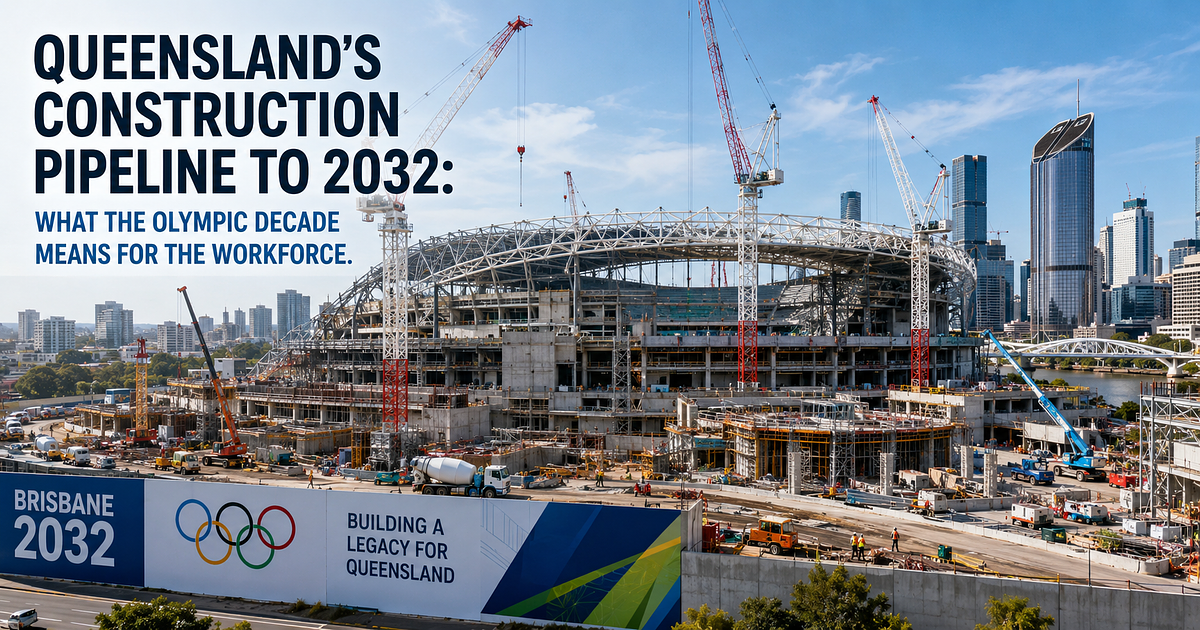
Queensland's Construction Pipeline to 2032: What the Olympic Decade Means for the Workforce
Queensland is in the middle of one of the most significant construction build-up periods in its history. A confluence of factors long-term infrastructure investment, a booming resources sector, renewable energy expansion, and the approaching 2032 Brisbane Olympic and Paralympic Games is driving the state's construction pipeline to levels that will test workforce capacity for the remainder of the decade.
For workers, employers and recruiters operating in or around Queensland construction, understanding the scale and timing of this pipeline is genuinely useful. The demand is real. The workforce pressure is real. And the opportunities for those positioned correctly are substantial.
The Scale of Queensland's Construction Pipeline
Construction Skills Queensland (CSQ) forecasts the state's construction pipeline value rising from $53 billion to $77 billion by 2027. That's a 45% increase in the value of active construction work across a single state over a three-year period and it spans multiple sectors simultaneously.
The peak of construction demand is projected for 2027/28, when Olympic infrastructure delivery converges with energy transition projects, resources investment and ongoing transport programmes. CSQ's modelling forecasts a workforce shortfall of up to 35,000 workers at that peak an extraordinary demand gap that will require sustained, coordinated workforce development responses across training, migration and industry policy to even partially address.
For context, 35,000 is not a rounding error. It's the equivalent of a mid-size regional city's entire workforce. The implications for project delivery, wage pressures and employer competition for labour are significant.
What the Olympic Infrastructure Programme Involves
The 2032 Brisbane Games are not simply a stadium and a ceremony. The Olympic and Paralympic infrastructure programme encompasses venues, athlete villages, transport connections, urban renewal precincts and supporting facilities spread across South-East Queensland from Brisbane to the Gold Coast, Sunshine Coast, and regional venue locations.
The specific construction demands include:
- New and upgraded sports venues across multiple sites
- The athlete village a large-scale residential and facilities development that will transition to community housing after the Games
- Public transport upgrades, particularly rail connections between Brisbane and the Olympic corridor
- Road and active transport infrastructure in and around venue precincts
- Supporting civil works utilities, drainage, digital infrastructure
Beyond the direct Games infrastructure, the Olympic commitment has accelerated broader South-East Queensland transport investment that would otherwise have taken longer to progress including Cross River Rail and associated urban development along the corridor.
The Queensland government's response to its own Productivity Commission review has also flagged reforms to apprenticeship policy, licensing for skilled migrants, and training investment recognising that the pipeline cannot be delivered without a significant expansion of the construction workforce.
The Resources and Energy Layer
Olympic infrastructure is only one element of Queensland's construction pressure. The state's resources sector centred on the Bowen and Galilee Basins for coal, and increasingly on critical minerals including lithium and copper continues to generate sustained capital investment.
FIFO construction workforce demand from the resources sector overlaps directly with the civil and building workforce needed for Olympic infrastructure. Both are drawing from the same labour pool. In practical terms, a civil supervisor or experienced plant operator choosing between a FIFO mining construction role in central QLD and an Olympic infrastructure civil role in South-East Queensland has genuine options and the competition for that person's commitment is intense.
As noted in Australia's broader construction pipeline overview, Queensland sits at the intersection of multiple simultaneous demand drivers in a way that few other states can match.
Where the Workforce Pressure Is Most Acute
CSQ's data points to a shortage of around 19,000 workers annually across the forecast period not just at peak. The persistent gap reflects the structural nature of the shortage rather than a single year's demand spike.
The trades and roles under most consistent pressure:
- Carpenters and formwork workers driven by residential and commercial building alongside Olympic venue construction
- Civil labourers and earthworks operators transport and utilities projects throughout the pipeline
- Electricians across building, infrastructure and energy projects
- Plumbers residential and commercial demand running simultaneously with infrastructure
- Project managers and site supervisors management capacity is arguably more constrained than trade capacity in some segments
For workers in these trades, Queensland's pipeline represents consistent employment for years. For employers, it reinforces the case for early workforce planning and investment in training and retention the pool of available experienced workers will only get tighter as the pipeline approaches its peak.
What This Means for Workers Considering Queensland
For construction workers on the eastern seaboard and for workers nationally who are open to moving Queensland's pipeline represents one of the most robust forward employment environments in the country.
A few practical points worth knowing:
- South-East Queensland (Brisbane, Gold Coast, Sunshine Coast) will see intensifying demand for commercial building, civil and utilities trades through to 2032
- Central and north Queensland will maintain resources-driven FIFO demand throughout this period
- Regional QLD renewable energy projects are adding a further layer of civil and electrical demand outside the SEQ corridor
- Wage and rate pressure is elevated across the state workers with strong references and current tickets are well-positioned to negotiate
Workers looking to understand how to position themselves for Queensland's pipeline will benefit from ensuring their tickets and trade qualifications are current and their resume clearly reflects Queensland-relevant project experience.
For Employers - Planning Around the Peak
Queensland's construction peak is not a surprise. The timing is well forecast, the projects are identified, and the workforce gap is documented. Employers who begin workforce planning and sourcing now rather than at the point of project mobilisation will be better positioned than those who enter the peak competing against dozens of other contractors for the same workers.
For employers sourcing candidates for Queensland's construction and civil pipeline, Construction Jobs Australia reaches an active audience of site-based workers across QLD and nationally, including workers open to relocation and FIFO arrangements. For direct candidate sourcing across the Queensland pipeline, CJ Recruitment Global
supports construction and resources employers with targeted candidate placement.
External source links used:
- https://www.csq.org.au (Construction Skills Queensland pipeline and workforce forecasts)
- https://www.abc.net.au/news/2026-03-17/qld-construction-worker-shortfall-ahead-2032-olympic-games/106459420