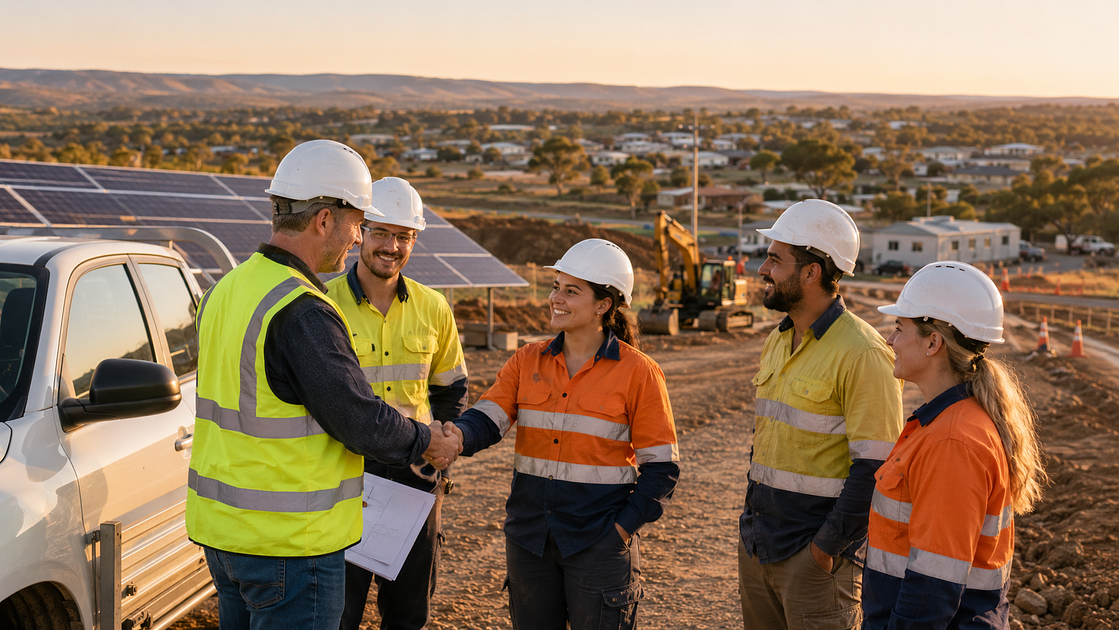
Regional Construction in Australia: Where the Work Is and Why It Matters
When people think about construction work in Australia, Sydney and Melbourne tend to dominate the mental image. But some of the country's most active and sustained construction pipelines are well outside the capital cities and the workforce demand in regional Australia is growing faster than in many metro markets.
Understanding where regional work is concentrated, and what is driving it, is useful for both workers considering a move and employers trying to source labour in tight markets.
What is driving regional construction demand
Several parallel forces are pushing construction activity into regional Australia:
Energy transition: The buildout of renewable energy: solar farms, wind projects, data centres, battery storage, transmission lines is happening overwhelmingly in regional areas. Large-scale solar and wind projects require significant civil works: road upgrades, substation construction, earthworks, fencing, cable trenching and more. The transmission lines needed to connect these projects to the grid run for hundreds of kilometres through regional corridors.
Mining and resources: Australia's resources sector is active across regional WA, Queensland, the Northern Territory and parts of South Australia and NSW. Critical minerals projects are opening new sites in areas that have had little previous construction activity. These projects need workers and they need them on FIFO or local-resident terms.
Water infrastructure: Dams, irrigation schemes, pipelines and water treatment facilities are significant components of state government infrastructure programmes, particularly in NSW, Victoria and Queensland. Water projects tend to be long-running and require a broad mix of civil, mechanical and electrical trades.
Road and transport upgrades: The federal and state highway networks require constant maintenance and periodic major upgrades. Regional roads, bridges and transport corridors represent steady civil construction work that extends across almost every state.
The workforce challenge in regional areas
Regional construction sites face a workforce challenge that is distinct from metro sites. There is often no large local labour pool to draw on. Workers either need to relocate or travel under FIFO-style arrangements. Regional accommodation markets can be tight when a large project comes to town, driving up housing costs and making local-resident hiring harder.
At the same time, Infrastructure Australia has flagged that the regional workforce deficit is expected to grow much faster than the urban deficit over coming years. Projects that need workers are projected to arrive in volume just as the supply of available regional workers runs out.
Opportunities for workers in regional construction
Workers who are willing to work regionally whether as residents, drive-in drive-out (DIDO) or FIFO are in a strong position. Regional premiums are common. Remote area allowances, travel support and accommodation assistance are frequently part of the package.
For workers who prefer to actually relocate rather than FIFO, regional construction towns during active project phases often offer strong local economies, affordable housing by capital city standards and a clear community need for skilled workers.
What employers sourcing regional labour should do
Regional sourcing is harder than metro sourcing full stop. Employers who wait until a project is about to start to begin looking for regional workers consistently struggle. The most effective regional labour strategies involve:
- Building a presence in regional communities before work begins
- Working with local GTOs, RTOs and industry associations
- Offering genuine relocation or accommodation support
- Advertising on platforms that reach the right audience nationally
CJ Recruitment Global, our recruitment partner, supports employers sourcing candidates for regional construction roles using a practical, proven workforce model built around reliable labour pipelines.
Read more about how this works here:
How regional employers can build more reliable labour pipelines