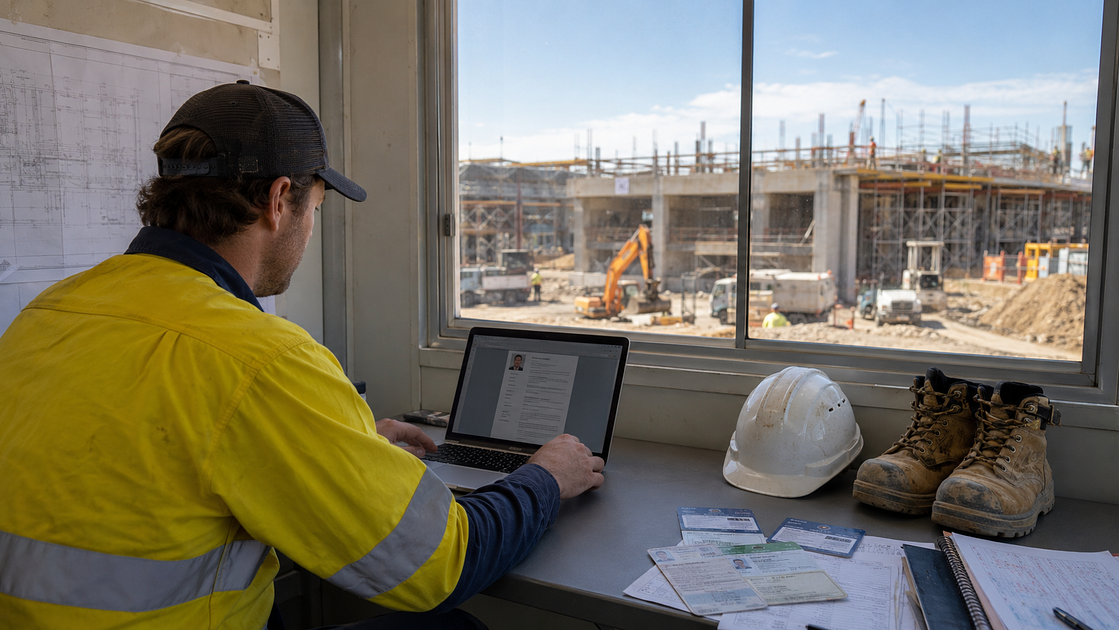
How to Write a Construction Resume That Actually Gets You Hired
Most construction workers are skilled on the tools but when it comes to putting together a resume, a lot of those skills get lost on a poorly formatted page. Recruiters and site managers reviewing stacks of applications aren't spending much time on each one. If your resume doesn't communicate the right information quickly, you'll miss opportunities you're qualified for.
This guide breaks down exactly what a construction resume needs to include, and what to leave out.
Start With the Basics And Get Them Right
Your resume doesn't need to be clever or creative. It needs to be clear, current and easy to scan. That means:
- Full name, phone number, and a professional email address (not something from 2006)
- Your location or the region you're willing to work in
- A brief two to three sentence summary at the top who you are, your trade or role, and how many years you've been working in the industry
A lot of construction workers skip the summary. Don't. A recruiter should be able to look at the top of your resume and immediately understand what kind of worker you are and where you fit.
List Your Tickets and Licences Up Front
In construction, civil and mining work, your tickets and licences are often more important than your job titles. A recruiter hiring for a civil project needs to know whether you have a valid white card, forklift ticket, EWP licence, or Class MR licence before they get to anything else.
Create a dedicated section near the top of your resume not buried at the bottom that lists:
- White Card (General Construction Induction)
- Driver's licences and class (HR, HC, MC, MR)
- Plant operation tickets (excavator, dozer, grader, loader, etc.)
- Working at heights, confined spaces, first aid
- Explosive licences or blasting tickets (if applicable for mining or civil)
- Any relevant trade qualifications or Certificate III/IV
Don't assume the recruiter will find this information if it's scattered through your work history. Put it where it can't be missed.
Write Your Work History the Right Way
Your work history is where most construction resumes fall apart. Workers either list job titles with no detail, or write paragraphs of vague descriptions that don't tell the recruiter anything useful.
For each role, include:
- Company name and rough location (e.g. Brisbane QLD, Pilbara WA)
- Role title
- Employment type: permanent, labour hire, contractor
- Approximate dates (month and year is fine)
- Three to five dot points on what you actually did
Those dot points should be specific. Instead of "general labouring duties," write "civil labouring on a $45M road widening project: concreting, formwork, traffic control." Instead of "operated machinery," write "Operated 20-tonne excavator on drain excavation and bulk earthworks."
Specificity builds credibility. It also helps your resume get picked up when recruiters are searching for specific skills.
Tailor Your Resume for the Job You're Going For
One of the most common mistakes is sending the same resume to every application. You don't need to rewrite it from scratch, but you do need to make sure the most relevant experience is visible.
If you're applying for an underground mining role, your mining experience should be front and centre. If you're going for a FIFO plant operator position, make sure your FIFO history and relevant plant tickets are prominent. If you're targeting civil infrastructure, lead with your civil project experience.
Look at the job ad before you apply. Note the key skills, tickets, and experience the employer is asking for and make sure your resume clearly shows you have those things.
Keep It Professional and Current
A few practical rules:
- Keep your resume to two pages where possible - three maximum for experienced tradespeople with long histories
- Use a simple, clean format. Avoid heavy graphics, multiple columns, or unusual fonts - these often break when uploaded to ATS (applicant tracking) systems
- Remove outdated roles from ten or more years ago unless they're directly relevant
- Your high school leaving grades are most likely irrelevant
- Update your resume every time you finish a significant project or pick up a new ticket
- Save it as a PDF before sending unless the employer specifies otherwise
Reference availability matters too. Have at least two people supervisors or site managers you can name as references. you should always ask referees permission and let them know in advance that you've listed them.
What to Leave Out
A few things that shouldn't be on your construction resume:
- A photo (unless you're applying in a country where this is standard in Australia, leave it off)
- Your date of birth or marital status
- Irrelevant jobs from early in your career that have nothing to do with construction
- Vague claims like "hard worker," "team player," or "great communicator" these mean nothing without evidence
Final Checks Before You Send
Before attaching your resume to any application, run through this checklist:
- Is my contact information current?
- Are all my tickets and licences listed?
- Is my work history in reverse chronological order?
- Have I tailored it for this specific role?
- Is it free of typos and formatting errors?
- Is it saved as a PDF?
- Are my references up to date?
A Good Resume Opens Doors - A Great One Gets You the Interview
Putting a bit of time into your resume is worth it. The construction industry in Australia is active, and there are genuine opportunities across civil infrastructure, mining, FIFO roles, and regional projects but those opportunities go to the candidates who are easiest to assess quickly.
Browse open construction, civil and mining roles at Construction Jobs Australia and make sure your resume is ready before you apply.