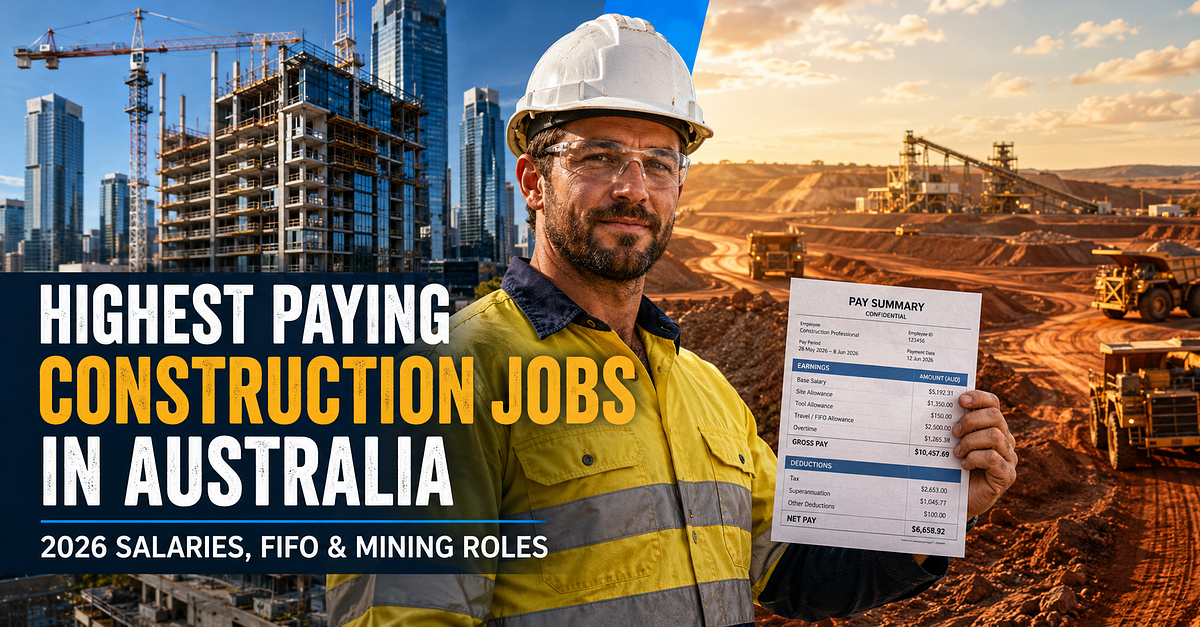
Highest Paying Construction Jobs in Australia (2026): Salaries, FIFO & Mining Roles Explained
Australia's highest paying construction jobs are concentrated on major civil infrastructure, mining, FIFO and tunnelling projects rather than small residential sites. In 2025–2026, experienced construction professionals and trades can realistically earn between $130,000 and $200,000+ per year, with some senior roles and remote FIFO packages going significantly higher when overtime and allowances are included.
Earnings over $150,000 are achievable, but they depend on experience, roster, overtime, allowances, location and project conditions. This guide breaks down which roles pay the most, how much FIFO and mining construction workers actually earn, and how site conditions push total packages well above base salaries.
Key salary findings
- Most site-based construction workers can earn between $90,000 and $150,000+ per year once overtime and penalty rates are included.
- Construction Managers and Project Managers on major projects commonly earn $130,000–$220,000+, with mining and remote roles at the upper end.
- Senior Project Engineers and Superintendents on major civil projects often sit in the $160,000–$250,000 range, especially with FIFO rosters.
- Mining and FIFO trades (electricians, mechanical fitters, boilermakers, diesel fitters, formwork carpenters) routinely earn $120,000–$190,000+ through high hourly rates and long shifts.
- Underground and tunnelling workers (TBM crews, underground electricians, tunnel superintendents) are among the best paid site roles, with packages often above $180,000 once allowances are added.
- Western Australia, Queensland and the Northern Territory tend to offer the highest construction salaries, driven by mining, resources and large remote infrastructure projects.
Highest-paying construction jobs in Australia
The highest-paying construction jobs in Australia are typically senior project leadership roles (Construction Managers, Project Directors, Project Managers, Superintendents) and specialist engineering positions on major civil, mining and tunnelling projects. On-site, the top-earning trades and operators are often FIFO and underground workers, particularly in Western Australia and remote mining regions.
Data from Jobs and Skills Australia's occupation profiles shows median weekly earnings for Construction Managers at around $3,751 per week, which equates to roughly $195,000 per year. Recruitment guides and industry surveys put typical Construction Manager and Project Manager packages on major infrastructure and mining projects in the $170,000–$220,000+ range.
Senior project and civil roles also sit high on the earnings ladder:
- Senior Project Engineer (civil/infrastructure): commonly $140,000–$185,000, with regional and FIFO positions at the top end.
- Project Manager (major projects): frequently $160,000–$220,000 depending on scope and employer.
- Site Supervisor / Superintendent: around $120,000–$220,000+, particularly on Tier 1 transport, tunnelling and mining projects.
- Mining Engineer / Senior technical roles: often $150,000–$250,000+ at tier-one operations.
On the tools, the highest earning construction workers tend to be underground electricians and HV technicians ($140,000–$190,000+), mechanical trades such as diesel fitters and heavy plant fitters ($110,000–$180,000), and FIFO formwork carpenters and steel fixers on mining and heavy civil projects ($120,000–$180,000+).
Construction salary comparison table
The table below shows indicative ranges for high-paying construction roles in Australia based on 2025–2026 data from Jobs and Skills Australia, industry salary guides and recent job advertisements.
| Role / Occupation | Typical base salary or rate | Potential total earnings (with overtime/allowances) | Where the highest rates are found |
|---|---|---|---|
| Construction Manager (major projects) | $150,000–$200,000 | $170,000–$230,000+ | Mining, heavy civil, Tier 1 infrastructure |
| Project Manager (infrastructure/civil) | $160,000–$220,000 | $180,000–$250,000 | Tier-one rail, tunnelling, mining |
| Senior Project Engineer (civil) | $140,000–$185,000 | $150,000–$200,000 | Regional/FIFO civil projects |
| Site Supervisor / Superintendent | $120,000–$180,000+ | $140,000–$220,000 | Major civil, tunnelling, mining |
| Mining Engineer | $150,000–$250,000+ | $170,000–$280,000+ | Tier-one mining operations |
| Underground Electrician / HV | $140,000–$190,000 | $150,000–$210,000+ | Underground mining, tunnelling |
| Diesel Fitter (underground, FIFO) | $75–$90 per hour | $170,000–$210,000+ | 12-hour shifts, 2/1 rosters |
| Boilermaker / Welder (mining FIFO) | $110,000–$150,000 | $130,000–$180,000+ | Heavy equipment, shutdown work |
| Electrician / Plumber (civil/mining) | $100,000–$140,000 | $120,000–$180,000+ | FIFO and remote projects |
| Civil Plant Operator (multi-ticket) | $90,000–$130,000 | $110,000–$160,000 | Excavators, cranes, dozers |
| Formwork Carpenter (FIFO, WA) | $120,000–$150,000 base | $140,000–$180,000+ | 12-hour days, site uplifts |
| Steel Fixer (mining/civil projects) | $95,000–$130,000 | $120,000–$160,000 | WA/QLD mining regions |
| Crane Operator (tower/mobile) | $100,000–$140,000 | $130,000–$180,000+ | Night shifts, shutdowns |
| Rigger / Scaffolder (FIFO) | $90,000–$130,000+ | $120,000–$170,000 | LAHA, long weeks |
Total earnings depend on overtime, roster, allowances and site conditions. Figures are before tax and exclude super unless otherwise noted.
Highest-paying construction trades
Among construction trades, the highest-paid workers in Australia are generally those who combine strong qualifications with remote, heavy civil or mining work. Electricians, mechanical fitters, boilermakers, diesel fitters, formworkers and civil plant operators on FIFO and underground projects commonly out-earn equivalent trades on metro residential jobs.
Construction Jobs Australia's wage analysis What Construction Workers Are Actually Worth Right Now highlights indicative trade ranges based on recent job ads and salary data:
- General labourer: typically $30–$45 per hour on residential/metro sites, higher on major civil and mining projects.
- Carpenter / joiner: around $40–$60 per hour, with top-end carpentry (especially formwork on remote projects) moving significantly higher.
- Bricklayer: $45–$65 per hour, with strong earners tied to high production rates.
- Electrician / plumber: $45–$70 per hour, depending on licence class and sector.
- Concreters / formworkers: $38–$60 per hour in typical settings, with FIFO formwork carpenters reported at $60–$65 per hour plus super on Pilbara mining camp projects.
- Civil plant operators: $40–$70 per hour, with multi-ticket operators and large machine specialists at the top end.
- Site supervisor (trade background): $120,000–$180,000+ per year on major projects.
On mining and resources projects, industry salary guides show mechanical trades (fitters, heavy plant) at $85,000–$110,000 at standard sites, rising to $150,000–$180,000 for experienced lead trades. Electrical trades commonly earn $90,000–$120,000, with experienced mining electricians at $120,000–$160,000 and underground/HV specialists above $160,000–$190,000.
For trades, the real difference is often not the base rate but sector (residential vs civil vs mining), roster (day-only vs 12-hour FIFO), and whether work is metro, regional or remote.
How much do FIFO construction workers earn in Australia?
FIFO construction workers in Australia typically earn between $100,000 and $200,000+ per year, depending on trade, experience, sector and roster. Entry-level FIFO roles often start around $70,000–$85,000, while experienced operators and tradespeople commonly earn $130,000–$180,000 once overtime and allowances are included.
Construction Jobs Australia's pay analysis notes that "FIFO roles generally" fall in the $90,000–$200,000+ band, with the upper range dominated by experienced trades, operators and supervisors on mining and heavy civil projects. This aligns with mining salary guides showing average mining salaries around $130,000–$140,000 per year, well above the national average.
Why FIFO jobs pay more
FIFO jobs pay more than comparable metro roles mainly because employers must compensate workers for remote locations, intensive rosters and time away from home. Higher hourly rates are only part of the picture – the real earnings jump comes when you combine long shifts, site loadings and included benefits.
The key drivers:
- Longer shifts and compressed rosters. Standard metro roles might be 38–45 hours per week. FIFO rosters often involve 10–12-hour shifts, with 2/1, 3/1 or 15:6 patterns that can push weekly hours toward 60–70.
- Remote and site allowances. Many enterprise agreements and company policies add loadings for remote work, underground conditions, hot climates or particularly risky environments. These can add 10–25% on top of base salary.
- Non-cash benefits. Accommodation, meals, site transport and sometimes travel are covered. Mining salary guides estimate these benefits can be worth an extra $30,000–$60,000 per year on top of the nominal salary for some FIFO packages.
- Overtime and penalty rates. Weekend work, night shifts and public holiday work attract premium rates, substantially boosting total earnings beyond the base hourly wage.
For example, a diesel fitter on a FIFO roster at $80 per hour working 12-hour days over a 2/1 cycle (roughly 8 months of work days per year) can easily exceed $200,000 in gross earnings, without any need to inflate the underlying hourly rate. The same trade working 8-hour days on a metro project at $55 per hour would earn significantly less over the year.
Are mining construction jobs better paid?
Mining construction jobs are generally better paid than equivalent roles in metropolitan residential or light commercial construction. Both trade and professional roles in the mining sector benefit from remote location allowances, higher base rates, longer shifts on compressed rosters, and additional benefits such as accommodation and travel.
For example, a FIFO formwork carpenter in WA can earn $60–$65 per hour plus super on a 2/1 roster of 12-hour days, equating to well into the $120,000+ range before bonuses and extra allowances. Underground electricians and HV specialists can earn packages in the $140,000–$190,000 band, with some roles exceeding $200,000.
Mining and remote civil projects are heavily represented in the Mining Jobs Australia | FIFO, Underground & Open Cut Roles category on Construction Jobs Australia, which focuses specifically on these higher-paying sectors.
The trade-offs include remote locations, longer shifts, rostered work, time away from home, harsher conditions and greater experience/ticket requirements.
Tunnelling and underground construction jobs
Tunnelling and underground construction roles – including TBM (Tunnel Boring Machine) crews, underground electricians, tunnel superintendents and specialist fitters – sit near the top of the pay scale for site-based construction workers in Australia. These jobs are concentrated around major rail and road tunnel projects and underground mining operations.
Civil and mining salary data shows that underground and remote roles attract higher base salaries than metro equivalents, location premiums of 10–25%, and additional risk and underground allowances. Mining salary benchmarks highlight underground electricians and HV technicians as a standout group, with typical packages in the $140,000–$190,000 range and some roles exceeding $200,000 including allowances.
Major urban tunnelling projects (metro rail, road tunnels) provide high-paying opportunities for TBM operators and tunnelling crews, tunnel superintendents and supervisors, specialist civil plant operators and riggers. These roles frequently offer above-average rates due to the combination of technical complexity, shift work (including nights) and tight project timelines.
Candidates interested in tunnelling and underground work can browse dedicated roles in:
- Tunnelling jobs – Australian underground and TBM roles.
- Tunnelling & Mining Overseas jobs – international tunnelling and mining projects.
Where are construction workers paid the most in Australia?
Construction salaries are generally highest in Western Australia, Queensland and the Northern Territory, particularly on mining, remote civil and FIFO projects. Among the eastern states, New South Wales and Victoria offer strong pay at the top end for major transport, tunnelling and commercial projects, but remote mining regions usually still lead overall.
A recent Australian salary analysis for Construction Managers across states shows typical ranges of:
- WA: $135,000–$180,000+
- QLD: $130,000–$165,000
- NT: $130,000–$175,000
- NSW: $125,000–$160,000
- VIC: $120,000–$155,000
- SA: $115,000–$145,000
- ACT: $120,000–$150,000
- TAS: $105,000–$135,000
Civil engineering salary data tells a similar story. FIFO civil engineers in WA and NT often earn $130,000–$200,000+, compared with mid-level metro civil engineers in the $95,000–$120,000 range. Construction Jobs Australia's carpentry wage analysis also notes that the average advertised salary for carpenters in Western Australia is around $113,000 per year, substantially higher than the national average due to mining-region payouts.
In practical terms:
- If you want maximum earnings, targeting WA, QLD and NT mining/civil projects will usually beat staying solely in metro residential work.
- If you prefer to stay on the east coast, Sydney, Melbourne and Brisbane still offer high-end packages on rail, tunnelling and major highway upgrades, especially for senior engineers, project managers and site supervisors.
You can filter these opportunities geographically using the state pages on Construction Jobs Australia, such as Western Australia and Queensland.
Can construction workers earn more than $150,000 a year?
Yes. It is increasingly common for experienced construction workers in Australia – both professionals and trades – to earn over $150,000 per year, particularly on major civil, mining and FIFO projects.
Examples supported by current data:
- Construction Managers with median weekly earnings of $3,751, equivalent to roughly $195,000 per year.
- Project Managers on large infrastructure projects with typical salaries of $160,000–$220,000.
- Senior Project Engineers earning $140,000–$185,000, with regional and FIFO roles at the top end.
- Site supervisors and superintendents on major projects earning $120,000–$180,000+, often exceeding $150,000 when overtime is included.
- FIFO trades and operators (electricians, diesel fitters, boilermakers, formworkers) frequently gross $130,000–$180,000+, with some underground roles exceeding $200,000.
How to increase your construction earning potential
Construction workers increase their earning potential by combining formal qualifications with high-demand tickets, sector experience and willingness to work on remote or complex projects. In 2025–2026, the biggest uplift comes from:
- Professional qualifications. Degrees in civil engineering, construction management or project management, particularly when combined with chartered status or professional accreditation, underpin high-paying roles in project delivery.
- High-value trade licences. Full electrical licences, plumbing licences, HV endorsements, and specific welding or mechanical certifications command higher rates, especially in mining and heavy industry.
- Plant and lifting tickets. Tickets for cranes, advanced earthmoving plant, rigging, scaffolding and EWP (elevated work platforms) are essential for many high-paying site roles. Multi-ticket operators often sit at the upper end of hourly ranges.
- Underground and tunnelling experience. TBM operations, underground mining, shaft sinking and tunnel fit-out are niche skills with strong demand and correspondingly higher pay.
- FIFO and remote site exposure. Demonstrated ability to work safely and productively on FIFO rosters – including 12-hour shifts – positions workers for higher-paying contracts across mining and remote civil projects.
- Supervisory and leadership experience. Stepping up to leading hand, foreman, supervisor or superintendent levels creates a significant pay jump, often into the $120,000–$200,000+ bracket.
Government policy is also aimed at getting qualified migrant tradespeople into the Australian workforce faster. The 2026–27 Federal Budget is investing in faster skills recognition for migrant tradies, particularly in construction and electrical roles, which should broaden the pool of licensed workers available for high-paying projects.
Where to find high-paying construction jobs in Australia
You can find high-paying construction jobs in Australia by focusing on specialist platforms and filters that target civil infrastructure, mining, tunnelling and FIFO roles rather than generic job boards. Construction Jobs Australia is specifically built for this segment of the market.
Instead of searching broadly across all industries, you can go directly to:
- Construction Jobs – the main jobs hub for construction roles, with filters for industry, state, salary and roster.
- FIFO Jobs Australia | Mining, Construction & Shutdown Roles – dedicated FIFO job category covering mining, construction and shutdown work.
- Mining Jobs Australia | FIFO, Underground & Open Cut Roles – focused on mining-related roles including trades, operators, engineers and supervisors.
- Tunnelling jobs – major underground and TBM roles across civil infrastructure and mining.
- Civil engineer jobs – infrastructure, transport and civil engineering positions nationwide, including regional and FIFO projects.
- Trades & Services jobs – trade roles aligned with construction, mining and civil projects.
Because the audience on Construction Jobs Australia is industry-specific, candidates browsing these categories are not sifting through unrelated roles – they are seeing construction, civil, mining and FIFO jobs only. For employers and recruiters, that focus translates into more relevant applications; for workers chasing high-paying roles, it means a faster path to the projects where the best money is being offered.
FAQs
What are the highest-paying construction jobs in Australia?
The highest-paying construction jobs in Australia are senior project leadership roles (Construction Managers, Project Directors, Project Managers, Superintendents) on major civil and mining projects, and specialist engineering and underground roles (Senior Project Engineers, Mining Engineers, underground electricians and diesel fitters). Typical salary packages for these roles range from $170,000 to $250,000+, with some senior positions and high-performing underground specialists exceeding that when allowances and bonuses are included.
How much can construction workers earn in Australia?
Most experienced construction workers can realistically earn between $90,000 and $150,000+ per year, and in many cases more, depending on trade, sector and workload. Trades such as electricians, mechanical fitters, boilermakers and formworkers on mining and FIFO projects regularly gross $130,000–$180,000+. Metro residential roles typically sit at lower hourly rates and fewer hours per week, while major civil and mining projects—especially with FIFO rosters—offer the highest total earnings.
How much do FIFO construction workers earn?
FIFO construction workers generally earn $100,000–$200,000+ per year. Entry-level roles often start around $70,000–$85,000, and experienced trades and operators commonly earn $130,000–$180,000 once overtime and allowances are included. Some underground trades and supervisors exceed $200,000 when working sustained rosters.
Which construction trades earn the most?
The highest-earning construction trades are usually electricians (especially underground and HV), mechanical fitters and diesel mechanics, boilermakers/welders in heavy industry, formwork carpenters on remote or mining projects, civil plant operators with multiple tickets, and experienced riggers and crane operators on major civil and mining sites. These trades combine strong technical skills with sectors that pay premiums - mining, remote civil, tunnelling and shutdown work.
Where in Australia are construction salaries highest?
Construction salaries are generally highest in Western Australia, Queensland and the Northern Territory, driven by mining and remote resources projects. Among the eastern states, New South Wales and Victoria offer strong pay at the top end on major rail, tunnelling and highway projects, but remote mining regions still tend to lead overall.
Can construction workers earn more than $150,000 a year?
Yes. Many construction workers already do. Senior engineers, project managers, supervisors and specialist FIFO trades often earn more than $150,000 per year, with some individuals on major projects and intensive FIFO rosters reaching $200,000+ in total earnings.
Sources / Methodology
Salary figures in this article are drawn from Australian Government data (Jobs and Skills Australia occupation profiles), industry salary guides, reputable recruitment sources and current Australian job advertisements for 2025–2026. Where ranges are provided, they reflect variation by state, sector (residential vs civil vs mining), experience and roster. Total earnings figures include typical overtime, penalties, site allowances and FIFO loadings where applicable.
Key sources include Jobs and Skills Australia construction manager earnings data, mining and FIFO salary guides from specialist recruiters, and Construction Jobs Australia's own wage analysis articles.