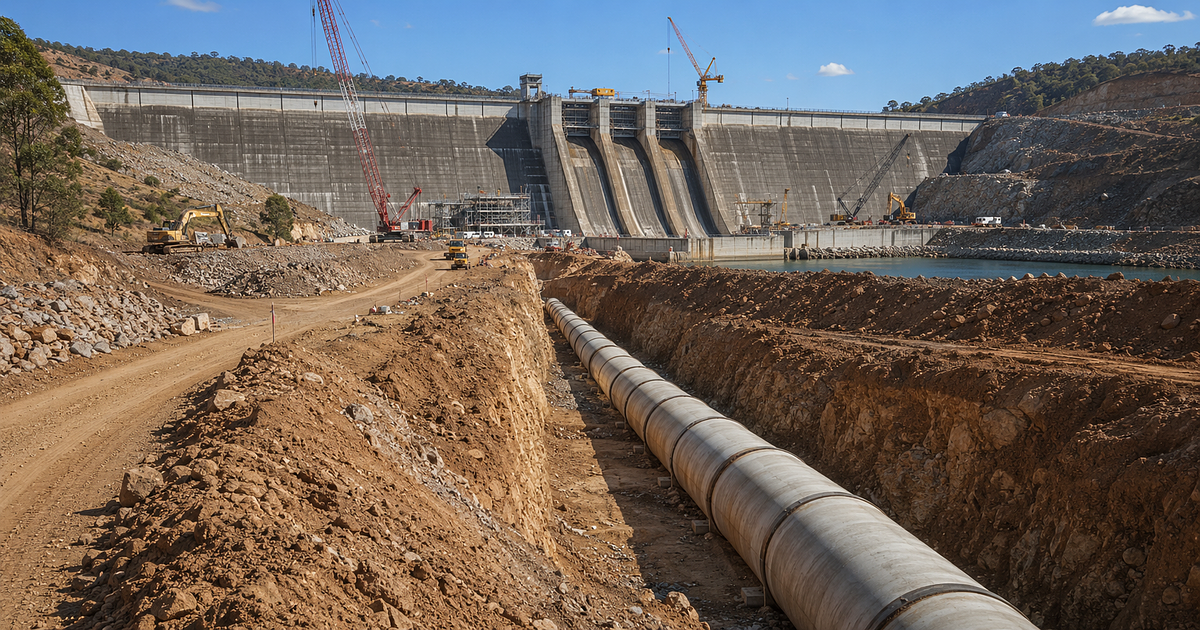
Water Infrastructure in Australia: The Projects That Are Quietly Driving Construction Demand
Water infrastructure rarely makes the front page. It doesn't have the visual drama of a highway interchange or the political profile of an Olympic stadium. But across Australia, a substantial and growing wave of water infrastructure investment is generating consistent civil construction demand and it's happening largely beneath the public radar.
Ageing treatment plants, growing populations, climate-driven water security concerns, and industrial demand from the mining and critical minerals sectors are all driving investment in dams, desalination plants, pipelines, water treatment facilities, and distribution network upgrades. For civil construction workers, this sector offers steady, varied project work that spans states and regions and the pipeline of committed investment is substantial.
What's Driving the Investment
Australia's water infrastructure challenge is structural. The country's population has grown significantly over the past two decades, placing increasing demand on water systems that were largely designed and built in the mid-twentieth century. Many of those assets are now at or beyond their design life and require upgrading, replacement or augmentation.
Climate variability has intensified the pressure. Reduced rainfall reliability in southern Australia, more frequent drought conditions, and the need for climate-resilient water supply have pushed water security up the policy agenda across multiple states. Infrastructure Australia's 2026 Priority List includes water security as a national priority, particularly for Perth and South-West Australia, where groundwater depletion has created a structural supply gap.
Industrial demand is adding a further layer. The critical minerals boom particularly in WA and SA requires substantial water supply for processing operations. Mining expansions, lithium refineries, and new industrial precincts all need water infrastructure investment as part of their project footprint, creating a direct link between the resources sector's growth and civil water construction demand.
Major Projects Currently Active or in Development
Northern Water - South Australia ($5 billion)
One of the most significant water infrastructure investments currently in development in Australia is the Northern Water project in South Australia a $5 billion desalination plant and pipeline proposal designed to supply water to BHP's Olympic Dam operation at Roxby Downs and broader industrial demand in the far north of the state.
The project is expected to generate more than 4,000 construction jobs annually during the build phase. A site south of Whyalla on the Spencer Gulf has been confirmed as the preferred location, and two consortia are in selection to deliver the project. The construction timeline projects operational delivery around 2032 meaning the peak civil construction phase is approaching.
For civil workers, the project scope includes marine and coastal civil works for the desalination plant, a major water pipeline across regional SA, pump stations, and all associated civil and services infrastructure. This is a significant regional construction programme in an area that will have limited competing labour demand a favourable environment for workers willing to relocate or access work on a FIFO basis.
Queensland - Utilities Pipeline
Queensland's population growth and expanded industrial base are driving sustained investment in water and utilities infrastructure across South-East Queensland and regional centres. Upgrades to water treatment plants, expansion of reticulation networks, wastewater treatment facility upgrades, and dam safety improvement programmes are all active across the state. The combined utilities infrastructure pipeline in QLD is a consistent source of civil, mechanical and electrical construction work that sits alongside the more visible Olympic and transport programmes.
Perth Water Security - WA
Perth's water security situation is well-documented and has been getting progressively more challenging as groundwater levels in the Perth Basin decline. The city's desalination capacity has been expanded in stages, and the case for further expansion alongside groundwater management and demand management infrastructure is reflected in Infrastructure Australia's current priority list. Any further desalination or water recycling investment in Perth represents a significant civil construction programme for a state already operating with a tight construction labour market.
Dam safety and water storage nationally
Across Victoria, NSW and QLD, dam safety improvement programmes are generating civil engineering and construction work that is less visible than new-build projects but consistently active. Spillway upgrades, embankment improvements, and structural assessments requiring follow-on remediation work are funded through state government water authority capital programmes and generate demand for specialist civil, geotechnical and hydraulic engineering crews.
What the Civil Workforce Needs
Water infrastructure construction has a specific workforce profile. The dominant demand is for civil rather than building trades, with significant plant operation content in pipeline, dam and marine civil works.
Key roles across water infrastructure projects:
- Civil labourers and earthworks crews pipeline trenching, plant pad construction, site preparation
- Pipe laying and jointing specialists particularly for large-diameter pressure mains and trunk water mains
- Concrete workers and formwork carpenters for water treatment structures, pump stations, and dam structures
- Mechanical and electrical tradespeople for plant installation, pump and valve fitting, and instrumentation
- Civil supervisors and project managers water infrastructure projects typically operate under highly regulated quality and environmental management frameworks, requiring experienced supervision
Water infrastructure projects also tend to have longer build programmes than resource construction projects particularly for dam and major treatment plant works. This suits workers looking for project stability over an extended period rather than the short-burst dynamic of shutdown and turnaround work.
The regional focus of many water projects also means that FIFO and regional construction experience is consistently valuable particularly for projects in remote SA, regional QLD and north WA.
What It Means for Long-Term Workforce Demand
Water infrastructure investment in Australia is not cyclical in the way that housing construction or commercial building is. The drivers population growth, climate variability, ageing assets and industrial demand are persistent and structural. They don't switch off when interest rates change or property markets cool.
Infrastructure Australia's assessment of the water sector describes it as a national priority for sustained investment over the next decade. That framing priority, decade-long is the kind of language that translates to sustained civil construction employment for workers who develop relevant experience in this sector.
As part of the broader picture described in why Australia's construction workforce shortage won't fix itself, water infrastructure is one of several simultaneous demand drivers that collectively make this period one of the most active in Australian construction history.
An Underappreciated Source of Consistent Civil Work
Water infrastructure doesn't command the attention of a major highway or a sporting venue but it generates real, well-funded, technically interesting civil construction work over extended periods. For civil workers looking to build consistent project experience, and for employers developing workforce pipelines for the years ahead, this sector deserves more attention than it typically receives.
Browse current civil, infrastructure and regional construction roles at Construction Jobs Australia