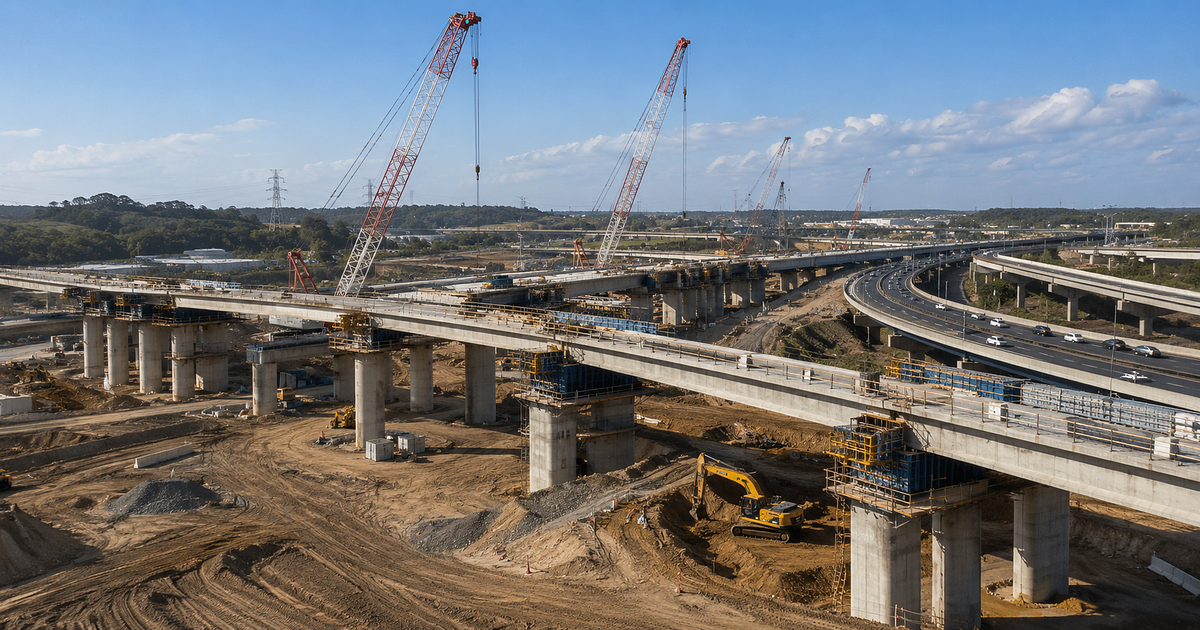
Australia's $242 Billion Infrastructure Pipeline: What It Means for Construction Jobs
Australia's publicly committed infrastructure pipeline has reached $242 billion - the highest level since Infrastructure Australia began tracking market capacity. This isn't a projection or an aspiration. It's funded projects already in the pipeline across transport, energy, housing and utilities, sitting across federal, state and territory government books and awaiting delivery.
For anyone working in or around construction, civil and mining, this number matters. It represents years of forward work, sustained workforce demand, and a pipeline of projects that will shape hiring patterns, regional economies and labour markets for the remainder of this decade.
Understanding what's driving that pipeline and where the pressure points are is useful for workers deciding where to focus their career, for employers planning workforce capacity, and for recruiters managing candidate pipelines.
What's Driving the Pipeline Growth
The $242 billion figure represents a $29 billion increase on the previous year's assessment. That growth hasn't come from one sector it reflects simultaneous expansion across several major investment areas.
Transport remains the largest single component at $129 billion, accounting for more than half the total pipeline. Roads, rail, bridges, ports and urban transport corridors continue to drive the biggest slice of civil and infrastructure spending. Major motorway upgrades, cross-city tunnel projects and interstate freight corridors are all active contributors.
Energy and utilities is the fastest-growing segment, with investment projected to more than double to $36 billion over the next five years. Transmission line upgrades, battery storage facilities, grid connections for new renewable generation, and water infrastructure projects are driving this surge.
Social and building including public housing, hospitals and schools adds $77 billion to the pipeline and is growing. These projects generate significant demand for commercial construction trades and building workers.
What this composition tells us is that the pipeline is diversified across project types and locations. It's not concentrated in one city or one sector. That matters for workforce planning demand is spread across the country, not just clustered in capital city CBDs.
The Workforce Gap Is Real and Growing
The pipeline would be unambiguously good news if the workforce existed to deliver it. It doesn't at least not yet. Infrastructure Australia's 2025 Market Capacity Report puts the current workforce shortfall at 141,000 workers, with projections indicating it could reach 300,000 by mid-2027 as project activity peaks.
The current shortage is concentrated in engineers, project managers and technical roles. Over the next two to three years, however, the demand will shift significantly toward tradespeople, plant operators, civil labourers and supervisors as projects move from planning and approval into active construction phases.
This is the transition that matters most for site-based workers and their employers. The pipeline is real, the money is committed, and the construction phase is coming. As covered in why Australia's construction workforce can't keep up with demand, this isn't a short-term spike it's a structural demand surge playing out over several years.
Regional Concentration Where the Work Is Going
One of the most significant features of the current infrastructure pipeline is how much of it is located outside capital cities. Energy transmission and renewable generation projects are almost universally regional. Defence infrastructure in WA, water projects in SA and the NT, and major highway upgrades across QLD, NSW and VIC are all adding to regional workloads.
Industry research from Macromonitor forecasts that regional construction activity will grow at twice the rate of capital city construction over the next two years a shift driven almost entirely by renewable energy, resources, and regional transport projects.
This has direct workforce implications. Regional construction activity means more FIFO and drive-in drive-out work, more demand for workers willing to relocate temporarily, and more competition for the limited pool of experienced workers already living and working in regional areas. For workers prepared for remote postings, the opportunities across regional Australia's construction pipeline are substantial and growing.
What It Means for Employers and Hiring
For employers, the scale of this pipeline creates both opportunity and risk. The opportunity is consistent, multi-year work across project types. The risk is the workforce cost of that work wages, allowances and recruitment costs are all elevated when demand outstrips supply, and that condition is expected to intensify before it eases.
Employers who are proactive about workforce planning building candidate databases, establishing labour hire partnerships, and investing in the retention of experienced workers will be better positioned to capitalise on the pipeline than those who recruit reactively as each project phase approaches.
The pipeline also creates a case for workforce investment. Projects running over several years justify investment in direct employment, training and upskilling rather than relying entirely on the labour hire market that every other employer is also competing for.
What the Pipeline Means for Workers
For construction workers trying to understand where the stable work is over the next three to five years, the infrastructure pipeline provides a clear directional guide:
- Civil infrastructure across all states, but particularly QLD, NSW and VIC
- Energy and transmission projects concentrated in regional SA, NSW, QLD and VIC
- Defence construction in WA
- Social housing and building construction in all capital cities
- Water and utilities projects nationally
Workers with civil, plant operation, structural, electrical and project supervision backgrounds are all well-positioned in this environment. Workers prepared to consider regional postings or FIFO arrangements have access to a broader range of opportunities than those restricted to capital cities.
A Pipeline of Genuine Scale
The $242 billion infrastructure pipeline is not a marketing number. It represents funded projects, committed budgets, and a sustained programme of construction activity that will run through the end of this decade. The workforce challenge is real but for workers and employers who are ready for it, so is the opportunity.
Browse current construction, civil and infrastructure roles at Construction Jobs Australia, where listings span the full spectrum of Australia's active project pipeline.
External source links used: