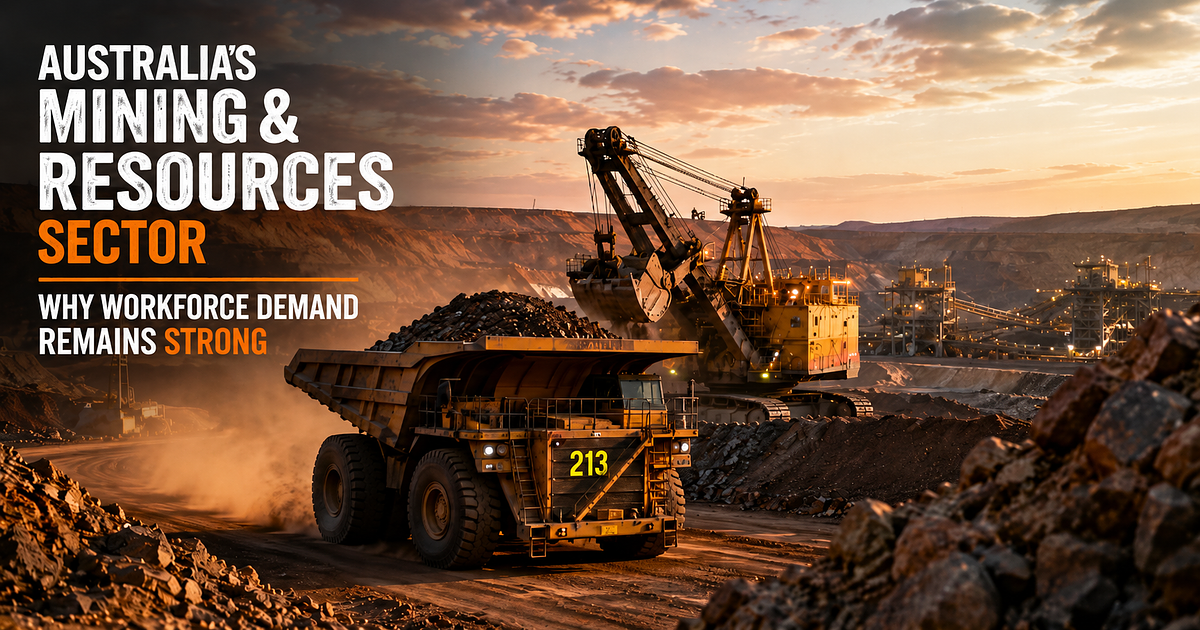
Australia's Mining and Resources Sector: Why Workforce Demand Remains Strong
Australia's mining and resources sector has been the backbone of the country's export economy for decades. It has survived commodity price cycles, global financial shocks, pandemic disruptions, and significant operational transformation and it continues to generate consistent demand for construction, civil, mechanical and FIFO workers at a scale few other industries can match.
For workers considering a move into resources, or employers planning workforce capacity for the years ahead, understanding why mining demand remains elevated and what's driving the next phase of activity is more useful than watching commodity price headlines week to week.
The Established Sector: Iron Ore, Coal, and LNG
Western Australia's Pilbara region remains one of the most active construction and operational mining environments in the world. Iron ore operations across the region spanning the major producers and their expanding contractor ecosystems generate consistent demand for plant operators, civil maintenance workers, shutdown specialists, and FIFO construction crews. The scale of infrastructure associated with these operations is immense: haul roads, processing facilities, ports, accommodation villages, pipelines and power infrastructure all requiring ongoing construction, maintenance and periodic expansion.
Queensland's Bowen Basin coal sector, despite the long-term energy transition narrative, continues to operate at high production levels. Metallurgical coal used in steel production remains in demand from Asian markets independent of the domestic energy debate, and capital investment in operational maintenance and capacity for Queensland coal assets continues.
The LNG sector concentrated off the north-west WA coast and in Queensland's Surat Basin represents some of the most significant fixed capital investment in Australian resources history. Ongoing operational maintenance of these facilities, along with periodic modification and upgrade projects, creates a sustained layer of skilled construction and mechanical work.
As explored in why FIFO workers are the backbone of Australia's remote construction and mining industry, the FIFO model that powers these sectors is deeply embedded in how the industry sources and manages its workforce.
The Critical Minerals Layer: The Next Wave of Growth
Beyond the established sector, Australia's critical minerals endowment is emerging as a major driver of new mining construction and operational investment. The global transition to electric vehicles, grid-scale batteries, and advanced manufacturing is creating demand for lithium, cobalt, nickel, copper, rare earths and other minerals where Australia has significant reserves.
Western Australia's lithium production has grown rapidly over the past five years and continues to attract capital investment. Projects across the Pilbara, Goldfields and South-West WA are generating demand for mining construction workforces including civil earthworks, processing facility construction, and accommodation and infrastructure establishment.
The recent discovery of significant additional iron ore reserves in WA described by geologists as potentially transformative for the state's resource base adds another layer of long-term investment signal on top of current activity.
The AMMA (Australian Resources and Energy Group) has identified plant operators, heavy diesel fitters and engineers as the three most persistently in-demand roles across the resources sector. For workers in these categories, the forward employment outlook in Australian mining is as solid as it's been in years.
Shutdown and Turnaround Work: The Hidden Workforce Demand
One of the most consistently misunderstood employment patterns in the resources sector is shutdown and turnaround work. This is the scheduled maintenance cycle for operating plant in refineries, processing facilities, offshore platforms, and mine infrastructure all require periodic shutdown for maintenance, inspection and modification.
For construction and maintenance workers, shutdowns represent:
- Short, intense bursts of work typically one to four weeks
- Higher pay rates reflecting the compressed timeline and technical demands
- Work available year-round as different facilities rotate through their maintenance cycles
- Entry points into longer-term site relationships for workers who perform well
Shutdown work is particularly accessible for experienced tradespeople and plant operators who are between longer projects. It keeps income consistent, builds relationships with site management, and often leads to direct offers for longer project roles. For workers who have developed the right ticket set, shutdown work is one of the most reliable sources of consistent employment in the resources sector.
WA: The Centre of Mining Workforce Demand
Western Australia consistently accounts for the largest share of Australian mining workforce demand. The combination of iron ore, gold, lithium, and LNG operations concentrated in the Pilbara, Goldfields, and the state's north-west makes WA the dominant resources employment state by a significant margin.
Current WA-specific demand drivers include:
- Ongoing Pilbara iron ore production and infrastructure maintenance
- Growing lithium and critical minerals construction in the mid-west and Goldfields
- The $12 billion AUKUS defence infrastructure commitment at Henderson representing a major construction programme with direct flow-on effects for WA's already-strained civil and structural labour market
- Offshore oil and gas maintenance and modification projects off the north-west coast
The WA construction and mining market is running tight. Accommodation in major regional centres is constrained. Wage rates are elevated. Workers with strong track records and current tickets have genuine leverage and employers who understand this are the ones planning further ahead.
What It Means for Workers and Employers
For workers considering the resources sector:
- Plant operators, heavy diesel fitters, civil workers and construction trades with current relevant tickets are well-positioned
- FIFO experience or the willingness to gain it significantly expands access to resources roles
- WA and QLD remain the primary employment geographies, with NT and SA adding further activity
- Critical minerals projects are generating new opportunities in areas that previously had limited resources activity
For employers:
- The competition for experienced FIFO workers across mining, civil and mechanical roles is intense and unlikely to ease in the near term
- Early sourcing and longer-term workforce relationships are more effective than reactive hiring at project mobilisation
- Skilled migration is an increasingly important supplement to domestic sourcing for specialist and hard-to-fill roles
Browse current mining, FIFO and resources construction roles at Construction Jobs Australia. For employers sourcing candidates across Australian and international markets for resources projects, CJ Recruitment Global provides dedicated construction and resources candidate sourcing.