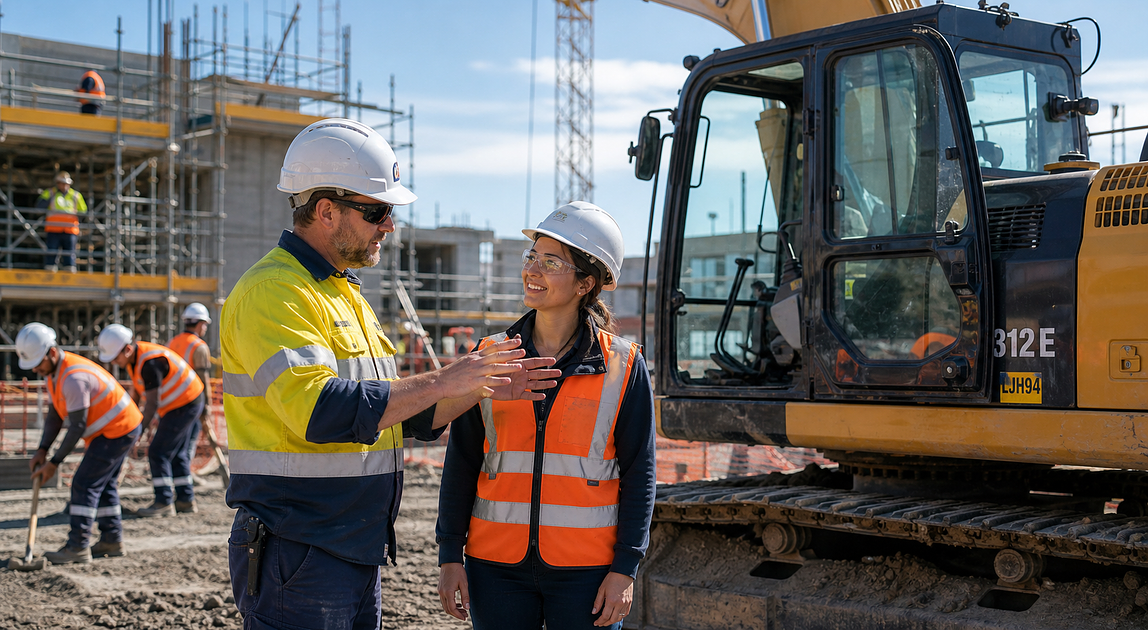
Women in Construction: Why the Industry Needs More of Them and What's Changing
Australian construction employs hundreds of thousands of people. But when you look at the breakdown, women make up a small fraction of the total workforce - particularly in site-based and trade roles. That matters not just for equity reasons, but for practical ones: the industry cannot afford to keep ignoring half the available workforce when it is short hundreds of thousands of workers.
The conversation around women in construction has shifted in recent years. It is no longer just about fairness. It is about workforce sustainability, productivity and the ability of the industry to deliver what Australia needs built.
The current picture
Women account for roughly 13 to 15 per cent of construction industry employment overall in Australia, with the proportion significantly lower in trade and site-based roles. The numbers are higher in project management, administration, design and engineering.
Progress is being made, but it is uneven. Some major contractors have set gender diversity targets. Some state government projects have required workforce diversity reporting as a condition of contract. But on the ground, many worksites remain a little behind with environments that are unwelcoming to women not through formal policy, but through culture, attitude and the absence of the basic facilities that make diverse teams functional.
Where women are entering construction
The clearest growth in women entering construction is in professional and management roles. project management, civil engineering, environmental roles and quantity surveying. These are areas where industry attitudes have shifted more quickly and where educational pipelines have improved.
In the trades, the numbers are lower but growing. Female electricians, plumbers, carpenters and civil operators are entering the workforce and building careers. Most report that once they are established on site and proven their competence, they are treated like any other skilled worker. The first few months tend to be the hardest.
Construction businesses that have built deliberately diverse teams - including women in site-based roles often report practical benefits: lower absenteeism, stronger communication and a positive effect on site culture overall.
The barriers that still exist
The most common barriers reported by women considering or already in construction careers include:
- Lack of female-specific amenities on site (toilets, change facilities, PPE that actually fits)
- Cultural attitudes that treat women as exceptions rather than workers
- Limited visibility of female role models in trades and site leadership roles
- Difficulty returning to site work after career breaks, particularly after having children
- Lack of flexible rostering options that make sustained careers possible
Some of these are practical issues with straightforward solutions. Others are cultural and take longer to change. But they are all addressable and the industry is increasingly under pressure to address them, particularly as major government projects attach diversity requirements to contract conditions.
What needs to happen
Increasing the proportion of women in construction, particularly in site-based roles will not happen by accident. It requires deliberate effort from employers, industry bodies, training organisations and project owners.
That means visible commitments from leadership, improved site facilities, mentoring programs for women entering trades, and flexible pathway options that do not require workers to disappear from the industry entirely when their personal circumstances change.
For workers who are women, the opportunity is real. The industry is short of skilled people, wages are strong, and there is growing support within organisations that understand what diverse teams deliver.
Construction Jobs Australia's role
Construction Jobs Australia is a platform for all workers across the industry - including women in construction, civil, mining and infrastructure roles. If you are a woman considering a construction career, or an employer building a more diverse workforce, Construction Jobs Australia is a useful starting point.
For more on where the workforce demand is coming from, read about the trades most in demand across Australian construction.