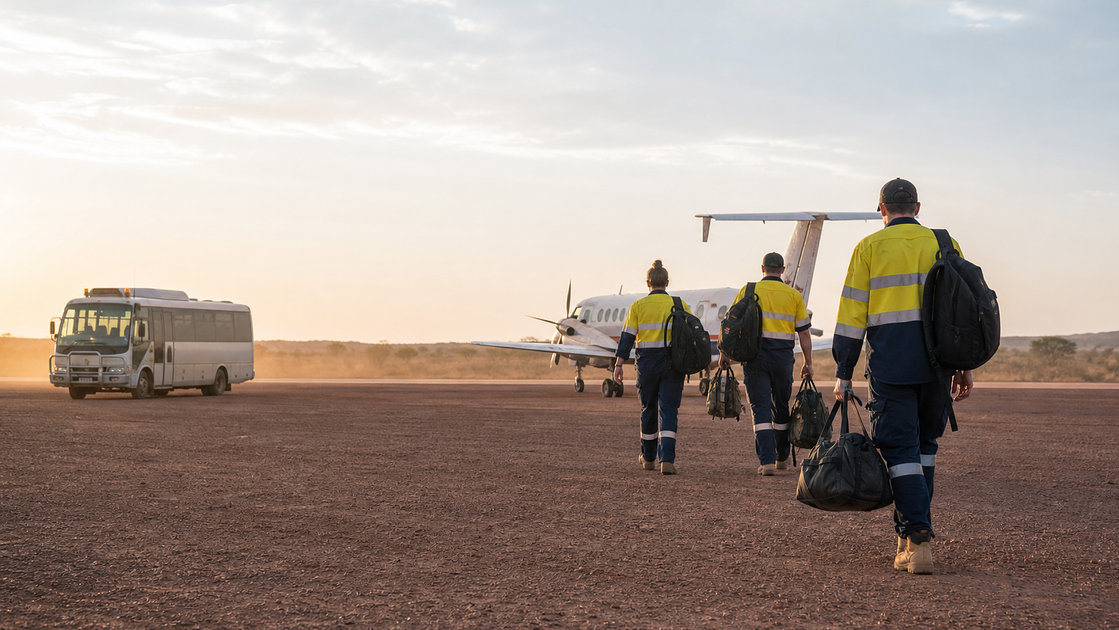
Why FIFO Workers Are the Backbone of Australia's Remote Construction and Mining Industry
Australia has some of the world's largest resource and infrastructure projects. Many of them are in some of the most remote places on earth - hours flights from the nearest town, far beyond the reach of the daily commute. The model that makes them work is fly-in fly-out employment, better known as FIFO.
FIFO is not a new concept. It has been the operational backbone of Australia's mining and resources sector for decades. But as infrastructure pipelines grow, energy projects expand and civil works push deeper into regional Australia, FIFO is becoming increasingly relevant beyond mining and more workers are considering it as a serious career model.
How FIFO actually works
The basic FIFO arrangement is straightforward. Workers are flown from a major departure point Perth, Brisbane, Darwin, Townsville etc.. to a remote site. They work a set roster (commonly two weeks on, one week off; eight days on, six off; or variations depending on the project) and then fly back home. Travel, accommodation, meals and camp facilities are covered by the employer.
This arrangement allows companies to staff projects in isolated locations without requiring workers to permanently relocate. For the worker, it means you can live in a city, maintain a home life and still access high-paying site work.
What FIFO pays
FIFO roles attract a wage premium compared to equivalent residential roles, in recognition of the lifestyle trade-offs involved. The average FIFO salary sits at around $113,000 per year, with experienced tradespeople and operators earning considerably more. Entry-level roles with no prior site experience typically start above $90,000. Specialist trades, supervisors and operators with multiple endorsements can earn between $160,000 and $200,000 or more.
Beyond the base rate, all-in FIFO packages include travel, camp accommodation and meals which materially increases the value compared to a straight salary figure.
What type of work is available FIFO
Historically, FIFO work was concentrated in mining coal, iron ore, gold, nickel, copper. That base remains strong, but FIFO now spans a broader range of sectors:
- Civil infrastructure: remote road construction, bridge works, pipeline projects
- Energy: gas processing facilities, offshore and onshore LNG, renewable energy installations in regional areas
- Construction: large-scale remote camp construction, processing facilities, maintenance shutdowns
- Shutdown and maintenance: planned and unplanned maintenance across mining and processing sites
Shutdown work, in particular, provides a well-paying and relatively accessible entry point for workers who want to test the FIFO model before committing to longer-term rosters.
The lifestyle reality
FIFO is well paid, but it comes with trade-offs that are worth being honest about. You are away from home for extended periods. The work is physically demanding and days are long. Typically ten to twelve hours, every day of the swing. Site environments can be isolated and monotonous.
The workers who thrive in FIFO tend to be those who have a clear sense of what they are working toward - whether that is paying off a mortgage, building savings, supporting a family or funding a life goal. Workers who are not well-matched to the lifestyle, or who underestimate the personal toll of extended time away, often find the arrangement unsustainable.
What's driving FIFO demand in Australia
FIFO demand in Australia is being driven by a combination of ongoing resource project activity and the expansion of major infrastructure and energy projects into increasingly remote regions. Western Australia continues to anchor the FIFO market, but Queensland, the Northern Territory, South Australia and New South Wales all have active FIFO-relevant projects.
The critical minerals boom — lithium, cobalt, nickel, rare earths is opening a new generation of remote project sites, many of them in areas that have no existing local workforce to draw on. These projects will be almost entirely FIFO-dependent.
Getting started in FIFO
If you are new to FIFO, the most practical steps are:
- Ensure your trade qualifications or tickets are current and nationally recognised
- Obtain a Standard 11 (S11) mining induction if you are targeting Queensland coal sites
- Build relevant white card, confined space, working at heights or high-risk work licences relevant to your target sector
- A recent national police check
- Look for shutdown or short-term FIFO contracts as a first step
Construction Jobs Australia lists FIFO roles across mining, civil, energy and infrastructure. Browse FIFO opportunities and connect with employers actively hiring at Construction Jobs Australia.
For more on where Australia's resource and infrastructure pipeline is heading, read about why Australia's construction workforce can't keep up with demand.