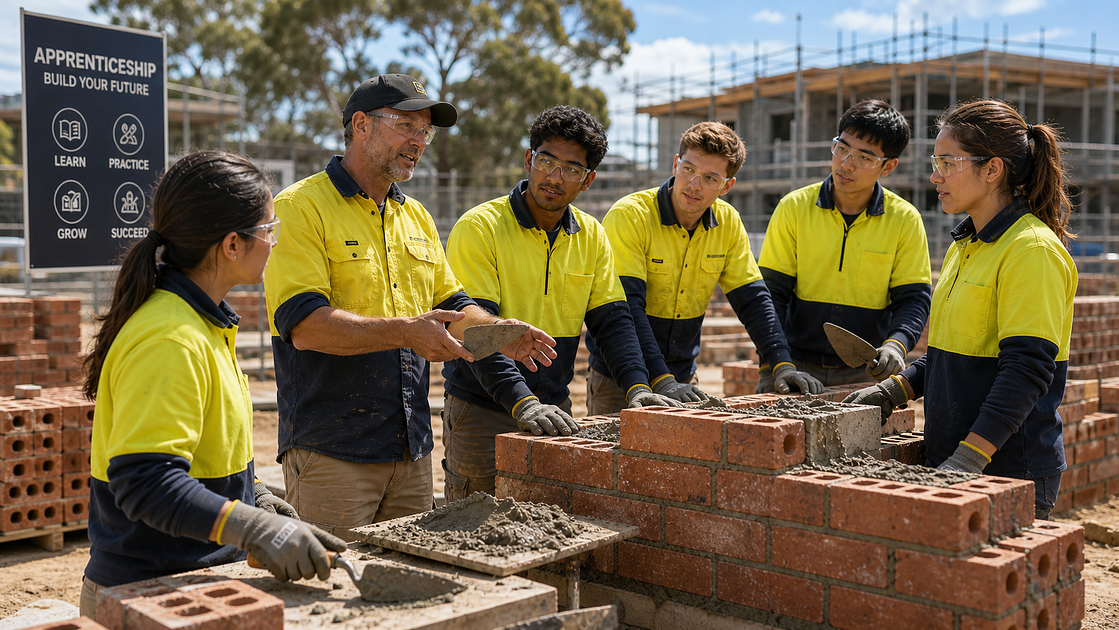
How Apprenticeships Are Required to Shape the Future of Construction in Australia
Apprenticeships have always been the backbone of the construction trades. They are how experienced workers enter the industry, how employers build reliable teams, and how the industry replenishes itself over time.
Right now, that replenishment pipeline is under pressure and the consequences are playing out across building sites and infrastructure projects around the country.
The apprenticeship situation in Australia
Australia's apprenticeship numbers spiked during and after the pandemic, driven by strong housing demand, government incentives and a push to get more people into trades. That spike has since softened. Between June 2024 and June 2025, trade apprenticeships fell by over seven per cent nationally. Non-trade apprenticeships fell by more than twenty per cent.
For construction specifically, this matters a lot. The industry already faces a significant workforce gap. If fewer people are starting apprenticeships now, the skilled workers needed for projects in three to five years will simply not be there.
Why apprenticeships matter more than ever
The current shortage of qualified tradespeople in Australia is not just a short-term supply issue. It reflects years of under-investment in training and a pattern of industry relying on importing skilled workers rather than growing its own.
That approach works when international pipelines are open and workers are willing to come. It becomes a problem when global competition for skilled labour increases, which it is and when visa and migration pathways cannot move fast enough to fill site-level gaps in real time.
Apprenticeships provide something that cannot be imported quickly: experienced, locally trained tradespeople who understand Australian standards, codes and worksite culture.
What makes a good apprenticeship pathway in construction
The most successful apprenticeship pathways in construction share a few common features:
- They connect training with real site work early, rather than keeping apprentices in classroom environments for long periods.
- They involve mentorship from experienced tradespeople who are invested in passing on skills.
- They offer structured progression — not just a fixed term before a certificate is handed over.
- They provide fair pay, reasonable conditions and a line of sight to full-time employment at the end.
Employers who invest in this kind of structured apprenticeship pathway tend to build loyal, high-quality teams. Those who treat apprentices as cheap labour with minimal supervision tend to lose them to other employers, other industries or to the trades entirely.
The role of group training organisations
Group training organisations (GTOs) play an important role in the construction apprenticeship market, particularly for smaller contractors who cannot commit to a full-term apprenticeship on their own. GTOs employ the apprentice and host them across multiple sites and contractors, giving the apprentice broader experience while managing the employment relationship centrally.
For small and medium-sized construction businesses, partnering with a GTO can be a practical way to access trained trade labour without the full commitment of a direct apprenticeship.
What this means for workers considering a trade
If you are thinking about a career in construction trades, the timing is actually good - despite the headline decline in apprenticeship numbers. Demand for qualified tradespeople is strong, wages are competitive and the industry needs people.
Construction offers solid career pathways, the ability to specialise across multiple sectors (residential, civil, mining, energy), and the option to move into supervision and management roles over time. A trade qualification in construction is genuinely portable and continues to carry value.
What employers should be doing
Construction employers who are serious about workforce stability should be investing in apprenticeships now, not when the shortage becomes acute on their own projects. The three to four year investment in an apprenticeship pays back in a reliable, trained worker who knows your systems, your sites and your standards.
Employers who combine direct apprenticeships with platforms like Construction Jobs Australia for sourcing experienced trades when project demand spikes put themselves in a stronger position to deliver across different project phases.
Browse construction, civil and trades roles at Construction Jobs Australia, or read more about the trades most in demand across Australian construction.